Best Nvme SSD Docking Stations in 2026: 8 Picks Ranked by Specs
As an Amazon Associate we earn from qualifying purchases. Links on this page are affiliate links.
Finding the right NVMe SSD docking station lets you manage fast external storage and duplicate drives without internal installations. The SABRENT Dual-Bay NVMe Cloner Dock leads the rankings because it offers dual-bay M.2 connectivity with offline cloning support and 10Gbps transfer speeds over USB-C.
For this guide, 8 products were compared using only the specifications published on their listings. This comparison helps you choose the ideal dock for your required port speeds, drive bay capacity, and duplication workflow.
Quick picks
The best fit for you
- You need offline cloning and dual-drive access over USB-C SABRENT Dual-Bay NVMe Cloner Dock It offers dual bays, 10Gbps USB-C transfer speeds, and standalone offline cloning with active fan cooling.
- You clone longer 22110 form factor NVMe drives offline MAIWO Dual-Bay 10Gbps NVMe Cloner Dock It features dual bays supporting extended 22110 NVMe drives and PC-free offline cloning at 10Gbps.
- You need 40Gbps transfers alongside standalone drive cloning ORICO 40Gbps Dual-Bay NVMe Cloner Dock This dual-bay dock provides 40Gbps USB-C connectivity paired with hardware offline cloning.
- You want maximum 40Gbps speeds for a single drive AMZPILOT 40Gbps USB4 M.2 NVMe Dock This compact aluminum dock delivers 40Gbps USB-C speeds for single M.2 NVMe drives.
Our 8 picks

SABRENT Dual-Bay NVMe Cloner Dock
Best for: offline NVMe cloning and dual-drive transfers
- Transfer Speed
- 10Gbps
- Supported Drive Types
- PCIe NVMe M.2 SSD
- Bay Count
- 2
- Offline Cloning
- One-button offline clone
- Supported M.2 Sizes
- 2230, 2242, 2260, 2280
- Cooling Type
- Aluminum body, built-in fan
This SABRENT dual-bay docking station connects two M.2 NVMe SSDs over a 10Gbps USB-C link. You can access both drives at the same time on your computer or clone drives offline without host software. It accepts 2230, 2242, 2260, and 2280 form factors with a tool-free lid. An aluminum body and active fan manage heat. It suits you if you need standalone drive duplication and dual-drive access.
Pros
- Standalone offline cloning without a host computer
- Simultaneous read and write access to both bays
- Supports 2230, 2242, 2260, and 2280 NVMe SSD sizes
- Aluminum body with built-in cooling fan
Cons
- Does not support M.2 SATA or AHCI SSDs
- Cooling fan runs continuously while powered with no idle shutoff
- Speed capped at 10Gbps USB 3.2 interface
Good fit if
- You need to duplicate NVMe drives without using a PC.
- You want concurrent access to two NVMe drives over one cable.
- You swap between different M.2 lengths from 2230 to 2280.
Skip if
- You require connection speeds above 10Gbps.
- You need compatibility with M.2 SATA or SATA-based storage.
- You need a silent dock that turns off its fan when idle.
Verdict: SABRENT Dual-Bay NVMe Cloner Dock provides push-button offline duplication and simultaneous dual-drive access at 10Gbps. The active fan and aluminum shell keep drives cooled under sustained operation.

MAIWO Dual-Bay 10Gbps NVMe Cloner Dock
Best for: standalone cloning across diverse NVMe lengths
- Interface
- NVMe (what this guide is about)
- Transfer Speed
- 10Gbps
- Supported Drive Types
- M.2 NVMe SSD
- Bay Count
- 2
- Offline Cloning
- One-key clone
- Supported M.2 Sizes
- 2230, 2242, 2260, 2280, 22110
The MAIWO Dual-Bay 10Gbps NVMe Cloner Dock is an external drive station designed to read two M.2 NVMe drives at once or duplicate them offline. It connects via a 10Gbps USB 3.1 Gen 2 interface and features a dedicated hardware clone button that copies data without a host computer. Because it fits five M.2 form factors from 2230 up to 22110, you can easily service standard and enterprise-length NVMe drives.
Pros
- One-key offline cloning without requiring a host computer
- Supports five M.2 sizes: 2230, 2242, 2260, 2280, and 22110
- Dual-bay architecture allows concurrent access to two drives
- Includes physical power switch and clone progress LED indicators
Cons
- Transfer speed tops out at 10Gbps USB 3.1 Gen 2 bandwidth
- Target drive capacity must be strictly larger than the source drive to clone
Good fit if
- You need to clone NVMe drives offline without using computer software.
- You use extra-long 22110 M.2 SSDs alongside standard consumer sizes.
- You want to mount and access two NVMe SSDs over a single USB connection.
Skip if
- You need 20Gbps or 40Gbps interface throughput for faster transfers.
- You want to clone to an SSD that matches the exact capacity of your source drive.
Verdict: MAIWO Dual-Bay 10Gbps NVMe Cloner Dock handles dual-drive reading and PC-free duplication with support for extended 22110 SSD lengths. It is a solid pick if you need reliable standalone cloning at 10Gbps speeds.

ORICO 40Gbps Dual-Bay NVMe Cloner Dock
Best for: Fast USB4 transfers and offline NVMe cloning
- Interface
- NVMe (what this guide is about)
- Transfer Speed
- 40Gbps
- Supported Drive Types
- M-Key NVMe
- Bay Count
- 2
- Offline Cloning
- One-button offline cloning
- Supported M.2 Sizes
- 2230, 2242, 2260, 2280, 22110
This dual-bay NVMe docking station delivers 40Gbps USB4 data transfers alongside one-button offline drive duplication. It accepts M-Key M.2 drives across sizes 2230 through 2280 up to 16TB total. Built-in fans and aluminum heatsinks manage high drive temperatures. If you need Thunderbolt 4 compatible bandwidth for fast file transfers or PC-free drive cloning, this dock fits your workstation.
Pros
- 40Gbps USB4 interface with Thunderbolt 4 compatibility
- One-touch offline cloning without connecting to a computer
- Active cooling system with built-in fan and aluminum heatsinks
- Supports M.2 2230, 2242, 2260, and 2280 sizes up to 16TB
Cons
- Compatible only with NVMe drives, offering no SATA SSD support
- 40Gbps transfer bandwidth is shared during simultaneous dual-drive operations
- Offline cloning requires the target disk capacity to exceed the source disk
Good fit if
- You need 40Gbps USB4 or Thunderbolt 4 transfer speeds for NVMe drives.
- You want to duplicate M.2 NVMe SSDs without connecting to a computer.
- You run sustained data transfers that require active fan and heatsink cooling.
Skip if
- You need to clone or read SATA-based M.2 SSDs.
- Your target cloning drive is smaller than or equal to the source drive.
Verdict: ORICO 40Gbps Dual-Bay NVMe Cloner Dock combines 40Gbps host connectivity with standalone drive cloning and integrated fan cooling for demanding NVMe workloads.

AMZPILOT 40Gbps USB4 M.2 NVMe Dock
Best for: single-drive high-speed NVMe swaps on USB4
- Interface
- NVMe (what this guide is about)
- Transfer Speed
- 40Gbps
- Supported Drive Types
- M.2 NVMe / PCIe 4.0 SSD
- Supported M.2 Sizes
- 2230, 2242, 2260, 2280, 22110
- Maximum Capacity
- 8TB
- Cooling Type
- Aluminium alloy case, cooling strips
The AMZPILOT 40Gbps USB4 NVMe SSD Dock gives you an external drop-in slot for bare drives without needing enclosures or screws. It delivers transfer rates up to 40Gbps over USB4 and accommodates M.2 NVMe PCIe 4.0 drives from size 2230 up to 22110, capped at 8TB. This single-bay reader suits you if you need fast, tool-free access to individual NVMe sticks across desktop and mobile operating systems.
Pros
- Up to 40Gbps USB4 bandwidth with backward compatibility for Thunderbolt 3/4 and USB standards
- Supports M.2 NVMe lengths from 2230 to 22110 with capacities up to 8TB
- Tool-free drop-in design enables fast drive swaps
- Includes a 1-foot USB4 USB-C to USB-C cable
Cons
- Not compatible with M.2 SATA or M.2 AHCI drives
- Single-bay configuration provides no offline drive cloning
- Drive surface temperature can exceed 60°C during active operation
Good fit if
- You need 40Gbps USB4 data throughput for individual M.2 NVMe SSDs.
- You regularly swap bare drives across multiple form factors up to 22110.
- You connect drives to multiple host platforms including Windows, macOS, Linux, Android, and iOS.
Skip if
- You need hardware-based dual-bay cloning without a host computer.
- You need to read or transfer data from M.2 SATA SSDs.
Verdict: AMZPILOT 40Gbps USB4 NVMe SSD Dock provides 40Gbps transfer speeds and broad NVMe size support in a compact aluminum form factor. It is an efficient single-drive solution if you do not require SATA compatibility or hardware duplication.

ORICO Dual-Bay M.2 NVMe Cloner Dock
Best for: PC-free NVMe cloning across multiple M.2 sizes
- Interface
- NVMe (what this guide is about)
- Transfer Speed
- 10Gbps
- Supported Drive Types
- M-Key NVMe PCIe SSD
- Bay Count
- 2
- Offline Cloning
- One-key clone
- Supported M.2 Sizes
- 2230, 2242, 2260, 2280, 22110
This ORICO dual-bay docking station accepts M Key NVMe PCIe drives in sizes from 2230 up to 22110. It operates across a 10Gbps USB 3.2 Gen2 interface and supports standalone offline cloning without a host computer. With an 8TB total capacity ceiling across two slots and an aluminum tool-free body, you get direct drive access. It fits your setup if you frequently duplicate drives or need fast external NVMe storage.
Pros
- Standalone one-key offline cloning without a host PC
- Supports M.2 NVMe form factors 2230, 2242, 2260, 2280, and 22110
- 10Gbps USB 3.2 Gen2 interface with UASP protocol support
- Tool-free aluminum enclosure with 10-minute auto sleep mode
Cons
- Does not support SATA or mSATA M.2 SSDs
- Maximum transfer rate caps at 10Gbps rather than 20Gbps or 40Gbps
- Target disk must be larger than source disk for offline cloning
Good fit if
- You need to clone NVMe drives without connecting to a computer
- You use longer 22110 M.2 NVMe SSDs alongside standard sizes
- You want a tool-free dual-bay dock supporting up to 8TB total capacity
Skip if
- You need to read or clone M.2 SATA or mSATA drives
- You require transfer speeds above 10Gbps for high-bandwidth workflows
Verdict: ORICO Dual-Bay NVMe Cloner Dock provides practical offline drive duplication and dual-slot NVMe expansion over a 10Gbps connection. It accommodates M.2 sizes up to 22110 in a compact, tool-free aluminum frame.

UGREEN Dual-Bay 20Gbps NVMe Cloner Dock
Best for: standalone dual-bay NVMe offline drive cloning
- Interface
- NVMe (what this guide is about)
- Transfer Speed
- 20Gbps
- Supported Drive Types
- M.2 NVMe
- Bay Count
- 2
- Offline Cloning
- One-click offline cloning
- Maximum Capacity
- 16TB
This dual-bay NVMe docking station gives you standalone offline drive cloning and 20Gbps data transfer speeds via a JMS586U controller. It accommodates two M-Key or B+M-Key M.2 NVMe drives up to 8TB each without tools. The open aluminum chassis supports TRIM, UASP, and S.M.A.R.T. monitoring. It suits you if you need rapid drive duplication or fast dual-drive desktop storage without connecting to a host computer during disk copies.
Pros
- 20Gbps transfer speed via JMS586U controller with UASP and TRIM
- One-click standalone offline cloning without a host computer
- Tool-free dual-bay setup supporting up to two 8TB NVMe drives
- Open all-aluminum frame with LED progress indicators
Cons
- Does not support SATA M.2 SSDs
- Target drive capacity must equal or exceed source drive capacity to clone
- Full 20Gbps speed requires compatible host ports and cables
Good fit if
- You need to duplicate NVMe M.2 drives offline without a computer.
- You use M-Key or B+M-Key NVMe drives up to 8TB in size.
- You have a 20Gbps-capable USB port and cable setup.
Skip if
- You need compatibility with SATA-based M.2 drives.
- You plan to clone to a target drive smaller than the source drive.
Verdict: UGREEN Dual-Bay 20Gbps NVMe Cloner Dock provides fast standalone cloning and high-speed data access for dual M.2 NVMe drives in an open aluminum enclosure. It delivers efficient drive duplication without host system intervention if you only use NVMe storage.
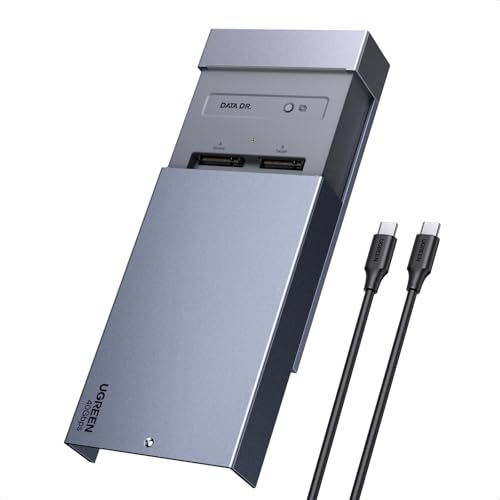
UGREEN 40Gbps Dual-Bay NVMe Cloner
Best for: High-speed drive cloning and dual-bay software RAID
- Interface
- NVMe (what this guide is about)
- Transfer Speed
- 40Gbps
- Offline Cloning
- One-click offline cloning
- Supported M.2 Sizes
- 2230/2242/2260/2280
- Maximum Capacity
- 16TB
- Cooling Type
- Aluminum alloy top shell, 40mm fan
The UGREEN Dual-Bay 40Gbps NVMe Cloner offers high-speed file transfers and standalone drive duplication without a host computer. You get a fast 40Gbps USB-C connection, dual M.2 bays accepting sizes from 2230 to 2280, and support for up to 16TB total capacity. Built-in software RAID modes and an active 40mm cooling fan make this dock suitable if you manage large backups, duplicate system drives, or configure striped or mirrored storage arrays.
Pros
- Up to 40Gbps transfer speeds over a USB-C interface
- One-click offline cloning functions without a host computer
- Supports Software RAID 0, RAID 1, PM, and Union modes
- Integrated 40mm direct-flow fan and aluminum top shell for active cooling
- Supports up to 16TB total across two M.2 NVMe drives
Cons
- Offline cloning requires the target disk to be larger than the source drive
- Does not support longer 22110 form-factor M.2 SSDs
Good fit if
- You need 40Gbps data throughput alongside standalone drive duplication.
- You want to configure dual M.2 NVMe SSDs in software RAID configurations.
- You work with standard M.2 NVMe drives in 2230, 2242, 2260, or 2280 sizes.
Skip if
- You need to clone to a target drive that is equal to or smaller than your source drive.
- You use SATA-based M.2 solid-state drives instead of NVMe drives.
Verdict: UGREEN Dual-Bay 40Gbps NVMe Cloner delivers 40Gbps transfer speeds alongside one-click offline cloning and versatile software RAID options. Its active cooling fan and dual-bay layout make it a capable tool for managing high-capacity NVMe storage.

ORICO Dual-Bay 20Gbps M.2 NVMe & SATA Dock
Best for: Silent dual-bay cloning and 20Gbps transfers
- Interface
- NVMe (what this guide is about)
- Transfer Speed
- 20Gbps
- Supported Drive Types
- M.2 NVMe, M.2 SATA
- Bay Count
- 2
- Offline Cloning
- One-key offline clone
- Supported M.2 Sizes
- 2230, 2242, 2260, 2280
This dual-bay drive dock delivers up to 20Gbps transfer speeds over a USB 3.2 Gen 2x2 connection. It accepts both M.2 NVMe and SATA drives across 2230 to 2280 sizes using a tool-free, open-top design. You can also duplicate drives without a computer via standalone offline cloning between matching protocols. It suits you if you need silent passive cooling and fast dual-slot access for system maintenance or large data transfers.
Pros
- 20Gbps USB 3.2 Gen 2x2 interface with UASP support
- PC-free standalone offline cloning between matching drive protocols
- Dual slots support both M.2 NVMe and SATA drives in 2230 to 2280 sizes
- Fanless 0dB passive cooling via an aluminum chassis
Cons
- Offline clone function requires identical protocols (NVMe to NVMe or SATA to SATA only)
- Full 20Gbps performance requires host support for USB 3.2 Gen 2x2
- No active cooling fan to manage sustained high-temperature writes
Good fit if
- You have a computer with a 20Gbps USB 3.2 Gen 2x2 port.
- You want to clone drives offline without using computer software.
- You prefer silent passive cooling over noisy cooling fans.
Skip if
- You need to clone data between an NVMe drive and a SATA drive.
- You want 40Gbps USB4 or Thunderbolt connection speeds.
- You require an active cooling fan for heavy continuous write cycles.
Verdict: ORICO Dual-Bay 20Gbps M.2 SSD Dock provides fast 20Gbps transfer capabilities and standalone offline cloning in a completely silent aluminum body. It is a solid choice if your system supports USB 3.2 Gen 2x2 and you clone between matching storage protocols.
Specifications side by side
| Spec | SABRENT Dual-Bay NVMe Cloner Dock | MAIWO Dual-Bay 10Gbps NVMe Cloner Dock | ORICO 40Gbps Dual-Bay NVMe Cloner Dock | AMZPILOT 40Gbps USB4 M.2 NVMe Dock | ORICO Dual-Bay M.2 NVMe Cloner Dock | UGREEN Dual-Bay 20Gbps NVMe Cloner Dock | UGREEN 40Gbps Dual-Bay NVMe Cloner | ORICO Dual-Bay 20Gbps M.2 NVMe & SATA Dock |
|---|---|---|---|---|---|---|---|---|
| Transfer Speed | 10Gbps | 10Gbps | 40Gbps | 40Gbps | 10Gbps | 20Gbps | 40Gbps | 20Gbps |
| Supported Drive Types | PCIe NVMe M.2 SSD | M.2 NVMe SSD | M-Key NVMe | M.2 NVMe / PCIe 4.0 SSD | M-Key NVMe PCIe SSD | M.2 NVMe | not specified | M.2 NVMe, M.2 SATA |
| Bay Count | 2 | 2 | 2 | not specified | 2 | 2 | not specified | 2 |
| Offline Cloning | One-button offline clone | One-key clone | One-button offline cloning | not specified | One-key clone | One-click offline cloning | One-click offline cloning | One-key offline clone |
| Supported M.2 Sizes | 2230, 2242, 2260, 2280 | 2230, 2242, 2260, 2280, 22110 | 2230, 2242, 2260, 2280, 22110 | 2230, 2242, 2260, 2280, 22110 | 2230, 2242, 2260, 2280, 22110 | not specified | 2230/2242/2260/2280 | 2230, 2242, 2260, 2280 |
| Maximum Capacity | not specified | 16TB | 16TB | 8TB | 8TB | 16TB | 16TB | not specified |
| Cooling Type | Aluminum body, built-in fan | not specified | Aluminum heatsinks, cooling fan | Aluminium alloy case, cooling strips | not specified | not specified | Aluminum alloy top shell, 40mm fan | Aluminum passive cooling |
| Interface | SATA III | NVMe | NVMe | NVMe | NVMe | NVMe | NVMe | NVMe |
| Form Factor | M.2 2280 | not specified | M.2 2280 | M.2 | M.2 | M.2 | M.2 | M.2 |
| Cooling | Cooling Fan | not specified | not specified | not specified | not specified | not specified | not specified | not specified |
| Features | Offline Clone | Offline Clone | Offline Clone | not specified | Tool-Free, Offline Clone | Tool-Free, Offline Clone | Offline Clone | Tool-Free, Offline Clone |
| Material | not specified | not specified | not specified | Aluminum | Aluminum | not specified | not specified | Aluminum |
| Host Interface | USB-C | not specified | USB-C | USB-C | not specified | not specified | not specified | not specified |
| Dimensions | 4.3 × 2.5 × 1.25 inches | 6.42 × 4.92 × 1.61 inches | 5.71 × 2.91 × 1.38 inches | 2.74 × 2.74 × 0.61 inches | not specified | 5.04 × 3.15 × 0.59 inches | 5.04 × 3.15 × 0.59 inches | not specified |
| Weight | 4 ounces | 1.46 pounds | not specified | 3.5 ounces | not specified | 10.6 ounces | not specified | not specified |
| Size | USB-C DUAL DOCK | not specified | IT28N | 2.74 x 2.74 x 0.61 inches | not specified | not specified | not specified | not specified |
| Color | SILVER | Black | Silver | Space Grey | Cool Gray | silver | silver | not specified |
| Model | EC-SSD2 | Dual M.2 NVME Cloner Dock with Switch | IT28N-C | Pilot C50D-R | M2P2-C3 | CM392 | 65733US | N2-C |
If you need a docking station, see our list of the best plugable docking stations for your setup.
How to Choose an NVMe Docking Station
-
Select Your Bay Count
Determine how many M.2 drives you need to connect at the same time. A single-bay docking station works well if you only need quick access to one drive for basic data backups or diagnostics. Single-slot designs also take up less desk space. If you regularly transfer files between two separate SSDs or duplicate data, choose a dual-bay unit instead. The AMZPILOT 40Gbps USB4 M.2 NVMe Dock provides a compact single-bay footprint if you do not need secondary drive bays or simultaneous dual-slot access.
-
Verify M.2 Length Compatibility
Check the physical dimensions of the SSDs you plan to install. While most consumer M.2 NVMe drives use the 2280 form factor, longer enterprise or specialty drives require 22110 support. Some docks only fit standard 2280 modules, which prevents longer circuit boards from seating correctly in the slot. If you handle drives from enterprise hardware or decommissioned servers, select a dock with extended tray space. The ORICO Dual-Bay M.2 NVMe Cloner Dock accommodates various M.2 sizes up to the extended 22110 length.
-
Evaluate Cooling and Noise
Review how the dock manages heat during continuous read and write tasks. Fast NVMe drives produce significant thermal output when processing large files. Docks with built-in active cooling fans push airflow directly across the drives to help prevent thermal throttling during intense workloads. However, cooling fans generate audible sound during operation. If you work in a quiet environment and prioritize silent desk hardware, look for a fanless aluminum chassis. The ORICO Dual-Bay 20Gbps M.2 NVMe & SATA Dock uses an aluminum enclosure for completely silent operation.
-
Check Standalone Cloning Needs
Decide whether you need to duplicate solid-state drives without powering on a host computer. Dual-bay docks with an offline clone feature allow direct drive-to-drive bit copy at the push of a button. This capability lets you clone operational systems or create complete drive backups independently. If you only plan to access files or format storage through your operating system, offline duplication hardware is unnecessary. The UGREEN Dual-Bay 20Gbps NVMe Cloner Dock features standalone offline cloning to duplicate drives without any host computer connection.
-
Look for Tool-Free Designs
Consider how often you swap out storage modules. Traditional external SSD enclosures frequently require tiny screws, screwdrivers, or thermal mounting brackets to secure a drive in place. Docking stations designed with tool-free slots let you insert and remove M.2 cards vertically or drop them into place in seconds. This open design is ideal for IT technicians, lab work, and multi-drive archiving where quick drive rotation matters. Check product specifications for tool-free features if you want to swap bare NVMe drives without handling hardware fasteners.
Frequently asked questions
Do you need a computer to clone drives using an NVMe docking station?
You do not need a computer if the docking station supports standalone offline cloning. Models like the SABRENT Dual-Bay NVMe Cloner Dock and the UGREEN 40Gbps Dual-Bay NVMe Cloner allow you to clone data directly between two inserted drives with push-button controls. However, single-bay units like the AMZPILOT 40Gbps USB4 M.2 NVMe Dock lack duplication hardware and require host system software for copying data.
What M.2 drive sizes fit into NVMe docking stations?
Most docks accommodate common M.2 form factors, but exact size support varies by model. While the ORICO 40Gbps Dual-Bay dock specifies the standard M.2 2280 size, docks like the MAIWO Dual-Bay 10Gbps NVMe Cloner Dock and ORICO M2P2-C3 support extended 22110 lengths. You should verify your drive length against the dock specifications before buying, especially if you handle enterprise-length SSDs.
How do NVMe docking stations manage heat during heavy data transfers?
NVMe docks use passive aluminum heat dissipation, active internal fans, or open-air frames to regulate temperatures. For instance, the SABRENT Dual-Bay dock and UGREEN 40Gbps cloner feature built-in cooling fans to actively circulate air around hot components. In contrast, units like the ORICO N2-C rely on a completely silent aluminum body, while the UGREEN CM392 uses an open aluminum layout to dissipate heat passively.
Can you configure software RAID on an NVMe docking station?
You can configure software RAID on dual-bay docks when connected to a host computer that supports multi-disk management. The UGREEN 40Gbps Dual-Bay NVMe Cloner explicitly supports dual-bay software RAID configurations over its high-bandwidth interface. Keep in mind that software RAID requires operating system support on your computer, as hardware-based drive duplication modes inside the dock are distinct from active host-managed disk arrays.
Do NVMe docking stations require tools to install SSDs?
Many NVMe docking stations use tool-free designs that let you slide or plug bare SSDs directly into the slot. The ORICO M2P2-C3 and ORICO N2-C are built specifically with tool-free interfaces, allowing you to swap bare M.2 drives in seconds without screws. This design makes top-loading docking stations practical if you frequently test, sanitize, or rotate through multiple NVMe solid-state drives.
What host interface connection do NVMe docking stations use?
Most modern NVMe docking stations connect to your computer using a USB-C port. Products such as the SABRENT EC-SSD2, ORICO IT28N-C, and AMZPILOT C50D-R utilize USB-C host interfaces to deliver bandwidth ranging from 10Gbps up to 40Gbps. You should plug these docks into compatible USB-C, USB4, or Thunderbolt ports to ensure you get the maximum rated transfer speed of the hardware.