Best M.2 Nvme SSDs: 15 Spec-Based Picks
As an Amazon Associate we earn from qualifying purchases. Links on this page are affiliate links.
Choosing the right m2 nvme SSD requires matching drive specifications to your system motherboard. This guide compares 15 drives based strictly on the specifications published on their official listings. The HP EX900 250GB PCIe NVMe M.2 SSD leads the lineup for entry-level Windows PC system drives, pairing a PCIe 3.0 interface with TLC flash.
You can review key hardware differences across PCIe generations, capacities up to 4TB, and physical form factors. This guide helps you decide which drive matches your motherboard slots, clearance, and host compatibility.
Quick picks
The best fit for you
- You need a basic boot drive for Windows. HP EX900 250GB PCIe NVMe M.2 SSD Its 250GB capacity and PCIe 3.0 TLC flash provide solid baseline performance for standard operating system use.
- You need integrated thermal cooling for a PS5 console. Seagate FireCuda 530 1TB Heatsink SSD It pairs verified PS5 compatibility with an engineered heatsink and PCIe 4.0 speeds reaching up to 7300MB/s.
- You need large storage capacity for PCIe 3.0 systems. PNY 2TB PCIe Gen3 M.2 SSD The drive delivers 2TB of M.2 capacity and PCIe 3.0 read performance up to 2,100 MB/s.
- You need high Gen4 throughput for heavy gaming workloads. Samsung 980 PRO 2TB PCIe 4.0 NVMe SSD The PCIe 4.0 interface provides read throughput up to 7,000 MB/s alongside 2TB of storage capacity.
Our 15 picks

HP EX900 250GB PCIe NVMe M.2 SSD
Best for: entry-level Windows PC system drives
- Form Factor
- M.2 (what this guide is about)
- Storage Capacity
- 250GB
- Interface
- PCIe 3.0 x4
- NAND Type
- TLC
- Dimensions
- 3.46 × 0.87 × 0.09 inches
The HP EX900 is an M.2 2280 solid state drive built on a PCIe 3.0 x4 interface with NVMe 1.3 support. It uses 3D TLC NAND flash memory and reaches sequential read speeds up to 2,100 Mbps and write speeds up to 1,500 Mbps. With a 200 TBW endurance rating and LDPC error correction, it gives you dependable everyday performance for upgrading a compatible Windows desktop or laptop PC.
Pros
- Sequential read speeds up to 2,100 Mbps and write speeds up to 1,500 Mbps
- Endurance rating of 200 TBW with 2M hours MTBF
- Built with 3D TLC NAND flash memory
- Higher order LDPC error correction for data integrity
Cons
- Limited to 250GB of total storage capacity
- Explicitly not intended for use in HP workstations
Good fit if
- You need a dedicated 250GB boot drive for a Windows PC.
- You want TLC flash memory with a 200 TBW endurance rating.
- You have an available M.2 slot supporting PCIe 3.0 x4.
Skip if
- You require more than 250GB of storage space.
- You intend to install the SSD in an HP workstation.
Verdict: HP EX900 250GB PCIe 3.0 NVMe M.2 SSD provides solid Gen3 read and write speeds with reliable 3D TLC endurance. It serves as an effective, straightforward primary drive upgrade for standard Windows PCs.
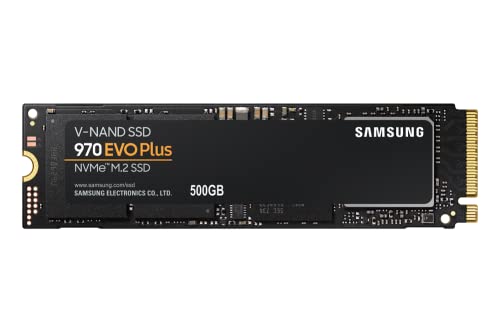
Samsung 970 EVO Plus 500GB NVMe M.2 SSD
Best for: fast PCIe Gen 3 builds
- Form Factor
- M.2 (what this guide is about)
- Storage Capacity
- 500GB
- Interface
- PCIe Gen 3.0 x4 NVMe 1.3
- Max Read Speed
- Up to 3,500MB s
- Max Write Speed
- Up to 3,300MB s
- Dimensions
- 0.87 × 0.09 × 3.15 inches
The Samsung 970 EVO Plus is an M.2 NVMe SSD offering 500GB of storage on the PCIe Gen 3.0 x4 interface. You get sequential read speeds up to 3,500 MB/s and sequential write speeds up to 3,300 MB/s, backed by a 600 TBW endurance rating or 5-year warranty. It suits you if you need reliable Gen 3 performance with AES 256-bit hardware encryption for daily computing or gaming.
Pros
- Sequential read speeds up to 3,500 MB/s and writes up to 3,300 MB/s
- Hardware AES 256-bit encryption with TCG/Opal V2.0 support
- Endurance rating of 600 TBW with a 5-year limited warranty
- Idle power consumption capped at 30 mW
Cons
- Limited to PCIe Gen 3.0 x4 bandwidth
- Does not support WWN
- 500GB capacity limits large media storage
Good fit if
- You want fast PCIe Gen 3 read speeds reaching up to 3,500 MB/s.
- You need hardware data protection through AES 256-bit encryption.
- You require high endurance up to 600 TBW.
Skip if
- You need PCIe Gen 4 transfer speeds.
- You need more than 500GB of local storage.
- You require WWN support for your configuration.
Verdict: Samsung 970 EVO Plus 500GB PCIe 3.0 NVMe SSD delivers balanced Gen 3 performance up to 3,500 MB/s with robust endurance and built-in security features.

Patriot P300 1TB PCIe 3.0 SSD
Best for: PCIe 3.0 systems needing reliable everyday storage
- Form Factor
- M.2 (what this guide is about)
- Storage Capacity
- 1TB
- Interface
- PCIe Gen 3 x4
- Max Read Speed
- Up to 2,100MB/s
- Max Write Speed
- Up to 1,650MB/s
- Dimensions
- 0.15 × 3.15 × 0.87 inches
The Patriot P300 is a 1TB internal M.2 SSD running on the PCIe 3.0 x4 interface. It delivers sequential read speeds up to 2,100 MB/s and sequential write speeds up to 1,650 MB/s, backed by built-in SmartECC and thermal throttling. This drive suits you if you need a reliable, standard-speed NVMe storage upgrade for general computing, office tasks, or expanding capacity on a PCIe 3.0 motherboard.
Pros
- Sequential read speeds reach up to 2,100 MB/s and write speeds up to 1,650 MB/s
- Equipped with SmartECC, LDPC, and end-to-end data path protection
- Includes thermal throttling technology to manage operating heat
- Backed by a 5-year manufacturer warranty
Cons
- PCIe 3.0 bandwidth is lower than modern PCIe 4.0 options
- Sequential read rate of 2,100 MB/s does not saturate the PCIe 3.0 x4 interface
- Random read IOPS specifications are not provided
Good fit if
- You need a 1TB NVMe drive to fit a PCIe 3.0 M.2 slot.
- You want built-in data protection technologies like SmartECC and LDPC.
- You run a Windows system from Windows 7 up through Windows 11.
Skip if
- You require the higher transfer speeds of a PCIe 4.0 drive.
- You need documented operating system support outside of Windows.
Verdict: Patriot P300 1TB PCIe 3.0 M.2 SSD delivers balanced PCIe Gen 3 transfer rates and hardware data protection for everyday computing. It is a practical fit for general desktop or laptop storage expansion.
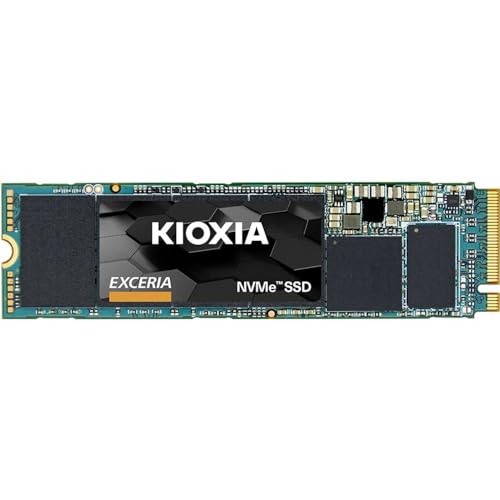
KIOXIA EXCERIA 500GB M.2 NVMe SSD
Best for: PCIe Gen3 systems needing 500 GB storage
- Form Factor
- M.2 (what this guide is about)
- Storage Capacity
- 500 GB
- Interface
- PCIe Gen3 x4
- Dimensions
- 3.94 × 2.76 × 0.28 inches
The Kioxia Exceria is an internal M.2 2280 solid state drive built with BiCS FLASH memory. Operating across a PCIe Gen3 x4 interface using NVMe 1.3c technology, it delivers throughput rates of 350,000 and 400,000 IOPS. With a 500 GB storage capacity, this drive fits standard M.2 slots in desktop motherboards and laptops. It suits you if you need a mid-capacity Gen3 NVMe storage expansion for everyday computing tasks.
Pros
- PCIe Gen3 x4 interface with NVMe 1.3c support
- Rated at 350,000/400,000 IOPS
- Built with BiCS FLASH memory
- Standard M.2 2280 form factor
Cons
- Limited to PCIe Gen3 transfer speeds instead of newer Gen4
- 500 GB capacity is lower than 1 TB and 2 TB alternatives
Good fit if
- You need a standard M.2 2280 drive for a PCIe Gen3 motherboard slot.
- You want 500 GB of NVMe storage for regular computing duties.
Skip if
- You need 1 TB or more of internal storage space.
- You require faster PCIe Gen4 data transfer rates.
Verdict: Kioxia Exceria 500GB PCIe Gen3 M.2 SSD provides standard Gen3 x4 performance and BiCS FLASH storage in an M.2 2280 layout. It serves as a dependable upgrade if your hardware requires up to 500 GB of NVMe capacity.

GIGABYTE AORUS 1TB PCIe 4.0 NVMe SSD
Best for: entry-tier PCIe 4.0 gaming setups
- Form Factor
- M.2 (what this guide is about)
- Storage Capacity
- 1 TB
- Interface
- NVMe 1.3, PCI-Express 4.0 x4
- Max Read Speed
- Up to 5000 MB/s
- Max Write Speed
- Up to 4400 MB/s
- Cache Type
- DDR4 1 GB
The GIGABYTE AORUS NVMe Gen4 1TB SSD is an internal M.2 drive built for PCIe 4.0 motherboards. It pairs 3D TLC NAND flash with a Phison E16 controller and a 1GB DDR4 cache buffer. You get sequential read speeds up to 5000 MB/s and sequential write speeds up to 4400 MB/s. This setup suits you if you want early Gen4 speeds with dedicated DRAM caching.
Pros
- PCIe 4.0 x4 interface reaching up to 5000 MB/s sequential read
- Dedicated 1GB DDR4 external cache buffer
- Built with 3D TLC NAND flash memory
- Random performance up to 750K read and 700K write IOPS
Cons
- Uses older NVMe 1.3 protocol instead of NVMe 1.4
- Peak read speed of 5000 MB/s sits below the fastest PCIe 4.0 drives
- Listed capacity options stop at 1TB
Good fit if
- You have a PCIe 4.0 system and want read speeds up to 5000 MB/s.
- You require a drive with an onboard 1GB DDR4 DRAM cache.
- You want 3D TLC flash instead of QLC NAND.
Skip if
- You need 2TB or larger storage capacity.
- You want top-tier PCIe 4.0 read speeds exceeding 7000 MB/s.
- You require the newer NVMe 1.4 specification.
Verdict: GIGABYTE AORUS NVMe Gen4 1TB SSD delivers dependable PCIe 4.0 x4 speeds up to 5000 MB/s backed by dedicated DDR4 memory and TLC flash. It provides a balanced Gen4 storage option without pushing into top-bracket transfer rates.

Seagate Barracuda Q5 1TB M.2 NVMe SSD
Best for: laptop and desktop storage upgrades
- Form Factor
- M.2 (what this guide is about)
- Storage Capacity
- 1TB
- Interface
- PCIe Gen3 ×4
- Max Read Speed
- 2400 MB/s
- Max Write Speed
- 1800 MB/s
- Compatibility
- Laptop, Desktop
The Seagate Barracuda Q5 is an internal PCIe Gen3 x4 M.2 2280 solid-state drive built with 3D QLC NAND flash memory. It provides 1TB of storage along with sequential read speeds up to 2400 MB/s and sequential write speeds up to 1800 MB/s. At 0.08 inches thin, it fits standard laptop or desktop M.2 slots. You will find it well suited for straightforward laptop storage upgrades, data migration, and general computing tasks.
Pros
- Sequential read speeds up to 2400 MB/s and write speeds up to 1800 MB/s
- Slim 0.08-inch profile fits both laptops and desktops
- Free Seagate DiscWizard software included for drive cloning
Cons
- Uses QLC NAND rather than TLC memory
- Read speeds peak at 2400 MB/s, below PCIe Gen4 capabilities
Good fit if
- You need a slim 0.08-inch M.2 drive for a laptop upgrade.
- You want DiscWizard software to clone an existing drive.
- You need 1TB of storage on a PCIe Gen3 x4 interface.
Skip if
- You require faster PCIe Gen4 sequential transfer rates.
- You prefer TLC flash memory over QLC NAND.
Verdict: Seagate Barracuda Q5 1TB M.2 SSD delivers balanced PCIe Gen3 speeds in a slim 0.08-inch form factor. It offers a straightforward storage expansion path for compatible laptops and desktop PCs.

PNY 2TB PCIe Gen3 M.2 SSD
Best for: high-capacity PCIe 3.0 laptop and desktop upgrades
- Form Factor
- M.2 (what this guide is about)
- Storage Capacity
- 2TB
- Interface
- PCIe Gen3 x4
- Max Read Speed
- Up to 2,100MB/s
- Max Write Speed
- 1,900MB/s
- Dimensions
- 0.87 × 3.15 × 0.16 inches
The PNY 2TB PCIe Gen3 M.2 SSD is an internal solid-state drive built for NVMe-compatible laptops and desktop PCs. It connects using a PCIe Gen3 x4 interface, reaching sequential read speeds up to 2,100MB/s and sequential write speeds up to 1,900MB/s. With 2TB of storage capacity and low power consumption, this drive suits you if you need a high-capacity M.2 upgrade from older SATA drives.
Pros
- Sequential read speeds up to 2,100 MB/s and write speeds up to 1,900 MB/s
- 2TB storage capacity in an M.2 form factor
- PCIe Gen3 x4 interface with low power consumption
- 5-year warranty with 24/7 US-based technical support
Cons
- PCIe 3.0 interface instead of faster PCIe 4.0
- Sequential read speeds cap at 2,100 MB/s
- No integrated heatsink listed in specifications
Good fit if
- You need 2TB of storage capacity for an NVMe-compatible laptop or desktop.
- You want an M.2 upgrade to replace a slower SATA SSD or hard drive.
- You prefer hardware covered by a 5-year manufacturer warranty.
Skip if
- You need Gen4 data transfer speeds for your workflow.
- You require sequential read throughput higher than 2,100 MB/s.
Verdict: PNY 2TB PCIe Gen3 M.2 SSD delivers large-capacity NVMe storage with up to 2,100 MB/s read speeds and a five-year warranty. It functions as a straightforward PCIe 3.0 upgrade for compatible systems.

Mustpoint M.2 NVMe to U.2 Adapter
Best for: mounting M.2 drives in U.2 bays
- Form Factor
- M.2 (what this guide is about)
- Interface
- NVMe
- Weight
- 4.83 ounces
This adapter card lets you install an M.2 PCIe NVMe drive into a standard 2.5-inch bay via a U.2 SFF-8639 interface. It offers native operating system support without requiring extra drivers, alongside backward compatibility with earlier PCIe generations. If you need to mount an M.2 SSD inside a server or desktop backplane designed strictly for 2.5-inch U.2 storage, this unit bridges the hardware gap cleanly.
Pros
- Converts M.2 PCIe NVMe drives to a U.2 SFF-8639 interface
- Fits standard 2.5-inch drive bays
- Native operating system support
- Backward compatible with earlier PCIe versions
Cons
- Provides adapter hardware only without integrated storage
- Requires a U.2 SFF-8639 host connection
Good fit if
- You need to install an M.2 NVMe SSD into a U.2 SFF-8639 port
- You want to house an M.2 drive inside a standard 2.5-inch drive bay
Skip if
- You need a complete SSD with built-in storage capacity
- You do not have a U.2 SFF-8639 host interface
Verdict: Mustpoint M.2 NVMe to U.2 Adapter provides the physical and electrical bridge necessary to run an M.2 NVMe drive in a 2.5-inch U.2 enclosure. It suits systems requiring U.2 connectivity with native operating system support and PCIe backward compatibility.

SABRENT Rocket 4 Plus 1TB PCIe 4.0 M.2 SSD
Best for: PCIe 4.0 setups needing configurable sector formatting
- Form Factor
- M.2 (what this guide is about)
- Storage Capacity
- 1TB
- Interface
- PCIe Gen4 x4
- Dimensions
- 3.15 × 0.86 × 0.11 inches
- Weight
- 1.76 ounces
This SABRENT Rocket 4 Plus is a 1TB M.2 solid-state drive built on the PCIe 4.0 x4 interface and NVMe 1.3 standard. It measures 0.11 inches thin, fitting standard M.2 slots without clearance trouble. The drive includes power management modes such as APST, ASPM, and L1.2, plus software for drive cloning. You will find it well suited for high-bandwidth storage setups requiring configurable 512-byte or 4K sector sizes.
Pros
- PCIe Gen4 x4 interface with NVMe 1.3 compliance
- Bundled Sabrent Acronis True Image cloning software
- Configurable 512-byte or 4K sector size utility
- Support for APST, ASPM, and L1.2 power management
Cons
- Complies with NVMe 1.3 instead of NVMe 1.4
- No built-in heatsink included in the specifications
Good fit if
- You need PCIe Gen4 x4 transfer capabilities in an M.2 slot.
- You plan to clone an existing drive using provided software.
- You require customizable 512-byte or 4K sector sizes.
Skip if
- You require native NVMe 1.4 protocol compliance.
- You want an SSD with a pre-installed heatsink.
Verdict: SABRENT Rocket 4 Plus 1TB PCIe 4.0 M.2 SSD delivers Gen4 x4 throughput and flexible sector formatting for compatible motherboards. It pairs a slim 0.11-inch profile with bundled cloning software for straightforward storage upgrades.

Samsung 980 PRO 1TB PCIe 4.0 SSD
Best for: PCIe 4.0 gaming and data analytics
- Form Factor
- M.2 (what this guide is about)
- Storage Capacity
- 1TB
- Interface
- PCIe 4.0 NVMe
- Dimensions
- 3.21 × 0.87 × 0.09 inches
This M.2 solid-state drive gives you 1TB of storage over a PCIe 4.0 interface. It features Samsung V-NAND technology built inside a standard M.2 form factor measuring 3.2 inches long and 0.09 inches thick. You get bandwidth designed for data analytics, graphics, and gaming workloads. It fits your system if you need a dedicated PCIe 4.0 NVMe drive for heavy-duty computing tasks.
Pros
- PCIe 4.0 interface
- 1TB storage capacity
- Samsung V-NAND technology
- Slim 0.09-inch profile
Cons
- No integrated heatsink listed
- Limited to 1TB capacity on this model
Good fit if
- You need a PCIe 4.0 NVMe drive for heavy workloads.
- You want 1TB of V-NAND storage in an M.2 slot.
Skip if
- You require more than 1TB of storage capacity.
- You need an SSD with an included heatsink.
Verdict: Samsung 980 PRO 1TB PCIe 4.0 NVMe SSD delivers V-NAND storage across a PCIe 4.0 interface for data-heavy computing. It provides a reliable 1TB M.2 option for systems supporting Gen 4 speeds.
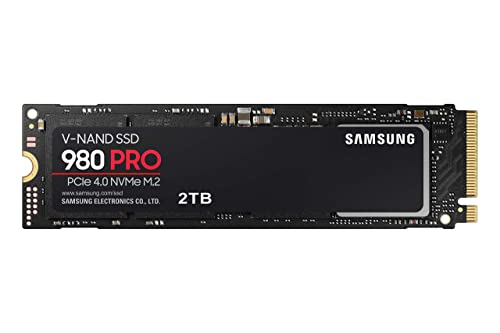
Samsung 980 PRO 2TB PCIe 4.0 NVMe SSD
Best for: High-speed PCIe 4.0 gaming and heavy workloads
- Form Factor
- M.2 (what this guide is about)
- Storage Capacity
- 2TB
- Interface
- PCIe 4.0 NVMe
- Max Read Speed
- Up to 7,000 MB/s
- Cooling
- Heat spreader label
- Compatibility
- Gaming
The Samsung 980 PRO is a 2TB PCIe 4.0 NVMe SSD built for high-demand computing. It operates in an M.2 2280 form factor and provides sequential read speeds up to 7,000 MB/s using an Elpsis controller. For heat dissipation, it incorporates a nickel-coated controller and a heat spreader label. You will benefit from its throughput during gaming, graphics editing, or data analytics.
Pros
- Sequential read speeds reach up to 7,000 MB/s
- PCIe 4.0 interface with PCIe 3.0 backward compatibility
- Proprietary Samsung Elpsis controller with nickel coating
- Heat spreader label handles NAND thermal management
Cons
- Lacks a dedicated preinstalled aluminum heatsink
- Sequential write speed is not stated in official specs
Good fit if
- You need up to 7,000 MB/s read performance on a PCIe 4.0 motherboard.
- You want 2TB of storage in a compact M.2 2280 slot for gaming or analytics.
- You require backward compatibility with an existing PCIe 3.0 system.
Skip if
- You need an integrated tall heatsink rather than a flat heat spreader label.
- You require confirmed sequential write specs before purchasing.
Verdict: Samsung 980 PRO 2TB PCIe 4.0 NVMe SSD provides up to 7,000 MB/s read throughput and 2TB capacity in an M.2 2280 footprint. It suits heavy workloads like gaming and data analytics when paired with PCIe 4.0 hardware.

Corsair MP400 2TB Gen3 NVMe M.2 SSD
Best for: PCIe Gen3 high-capacity M.2 storage upgrades
- Form Factor
- M.2 (what this guide is about)
- Storage Capacity
- 2TB
- Interface
- PCIe Gen3 x4, NVMe
- Max Read Speed
- 3,480 MB/s
- Max Write Speed
- 3,000 MB/s
- NAND Type
- QLC
The Corsair MP400 2TB is an M.2 2280 internal SSD using a PCIe Gen3 x4 NVMe interface. It delivers sequential read speeds up to 3,480 MB/s and sequential write speeds up to 3,000 MB/s. Built with high-density 3D QLC NAND, it provides 400 TBW endurance and includes Corsair SSD Toolbox management support. This drive suits you if you need high-capacity M.2 storage for PCIe 3.0 motherboards.
Pros
- Sequential read speeds up to 3,480 MB/s
- Sequential write speeds up to 3,000 MB/s
- Standard M.2 2280 form factor installs without cables
- Five-year warranty coverage
Cons
- Limited to PCIe Gen3 interface bandwidth
- 400 TBW endurance rating
Good fit if
- You need a 2TB M.2 2280 drive for a PCIe Gen3 motherboard slot.
- You want sequential read transfer rates up to 3,480 MB/s.
Skip if
- You require PCIe Gen4 transfer rates.
- You need write endurance higher than 400 TBW.
Verdict: Corsair MP400 2TB Gen3 NVMe M.2 SSD provides up to 3,480 MB/s reads and 2TB of high-density QLC storage. It is a solid choice for compatible PCIe 3.0 systems requiring cable-free M.2 installation.

Seagate FireCuda 530 4TB PCIe 4.0 SSD
Best for: maximum PCIe 4.0 capacity and speed
- Form Factor
- M.2 (what this guide is about)
- Storage Capacity
- 4TB
- Interface
- PCIe Gen4 ×4 NVMe 1.4
- Max Read Speed
- 7300 MB/s
- Max Write Speed
- 6900 MB/s
- Compatibility
- PS5
The Seagate FireCuda 530 is a high-capacity M.2 NVMe solid-state drive built with 3D TLC NAND flash. It uses the PCIe Gen4 x4 interface, delivering sequential read speeds up to 7300 MB/s and write speeds up to 6900 MB/s. With 4TB of storage space, it gives you vast capacity for large files and games. It also features listed compatibility with PS5 consoles, making it suitable if you need maximum speed and massive local storage.
Pros
- Up to 7300 MB/s read and 6900 MB/s write speeds
- Large 4TB storage capacity
- High-throughput PCIe Gen4 x4 NVMe 1.4 interface
- Built with 3D TLC NAND
- Documented PS5 compatibility
Cons
- No heatsink included in the listed specifications
- Requires a PCIe 4.0 system to hit maximum rated speeds
Good fit if
- You need 4TB of high-speed capacity for large files or game libraries.
- You want top-tier sequential transfer speeds up to 7300 MB/s.
- You are expanding storage on a PC or a compatible PS5 console.
Skip if
- You only have a PCIe 3.0 motherboard and cannot use Gen4 bandwidth.
- You do not need a high-capacity 4TB drive.
Verdict: Seagate FireCuda 530 4TB Gen4 NVMe SSD provides massive 4TB storage and top-tier PCIe 4.0 transfer speeds up to 7300 MB/s. It delivers reliable 3D TLC performance for high-throughput PC builds and compatible PS5 consoles.
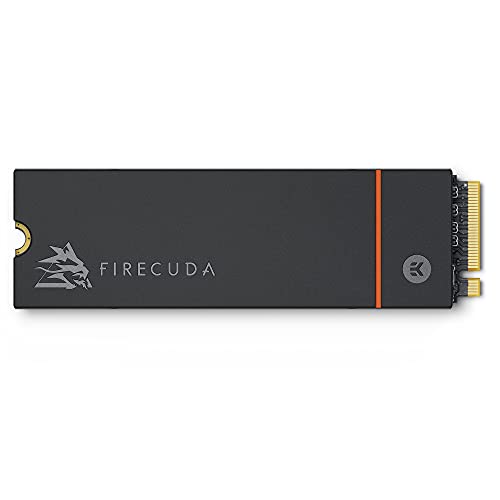
Seagate FireCuda 530 1TB Heatsink SSD
Best for: PS5 consoles and thermal-managed desktop setups
- Form Factor
- M.2 (what this guide is about)
- Storage Capacity
- 1 TB
- Interface
- PCIe Gen4 ×4 NVMe 1.4
- Max Read Speed
- Up to 7300MB/s
- Cooling
- Low-profile heatsink
- Compatibility
- PS5
This M.2 drive pairs 1TB of TLC storage with a pre-installed EKWB low-profile heatsink. Operating on a PCIe Gen4 x4 interface with NVMe 1.4, it delivers sequential transfer speeds up to 7300MB/s. You get hardware designed for PS5 expansion and desktop motherboards. It suits you if you demand sustained read throughput without relying on motherboard heat shields, backed by a five-year limited warranty and bundled data recovery.
Pros
- Integrated custom EKWB low-profile heatsink
- PCIe Gen4 x4 speeds up to 7300MB/s
- PS5 console compatibility out of the box
- Includes 3-year Rescue Data Recovery Services
- TLC NAND flash memory
Cons
- Pre-attached heatsink prevents installation in most laptops
- Limited to 1TB capacity on this specific configuration
Good fit if
- You need a drop-in drive with a pre-mounted heatsink for a PS5 console.
- You require fast PCIe 4.0 transfer rates up to 7300MB/s for sustained desktop tasks.
- You value bundled data recovery coverage alongside a five-year hardware warranty.
Skip if
- You plan to upgrade a notebook or slim laptop with clearance constraints.
- You require 2TB or 4TB of capacity for larger media and game libraries.
Verdict: Seagate FireCuda 530 1TB Heatsink SSD delivers PCIe 4.0 read speeds up to 7300MB/s paired with an engineered EKWB heatsink. It serves as a dependable cooling-ready upgrade for compatible desktop motherboards and PS5 consoles.

10Gtek Dual M.2 NVMe PCIe Adapter Card
Best for: adding dual M.2 NVMe drives via bifurcation
- Form Factor
- M.2 (what this guide is about)
- Interface
- PCIe 3.0
- Compatibility
- Desktop
- Bay Count
- Dual-Bay
- Weight
- 4.16 ounces
This 10Gtek card is a dual-bay expansion adapter that installs into a desktop PCIe 3.0 x8 slot. It allows you to host two M.2 NVMe or AHCI solid-state drives using sizes 2230, 2242, 2260, or 2280. Your motherboard and BIOS must support PCIe bifurcation to detect both installed drives. It suits you if you need to add two extra high-speed M.2 slots to an existing desktop system.
Pros
- Supports two M.2 NVMe or AHCI drives simultaneously
- Accommodates 2230, 2242, 2260, and 2280 length SSDs
- Includes both full-height and low-profile PCIe brackets
- Backward compatible with PCIe 2.0 and PCIe 1.0 motherboards
Cons
- Requires motherboard and BIOS bifurcation support to recognize both drives
- Does not support drive hot swapping
- Mounting screw is not included
Good fit if
- You have a desktop motherboard with PCIe bifurcation support.
- You need to mount two M.2 SSDs into a single PCIe 3.0 x8 slot.
- You use M.2 SSD lengths ranging from 2230 to 2280.
Skip if
- You have a motherboard that lacks PCIe bifurcation support.
- You require hot-swappable storage drives.
- You need mounting screws included in the package.
Verdict: 10Gtek Dual M.2 NVMe PCIe Adapter Card expands desktop storage by adding two M.2 slots through a single PCIe 3.0 x8 lane configuration. You must have bifurcation support in your motherboard BIOS to access both installed drives.
Specifications side by side
| Spec | HP EX900 250GB PCIe NVMe M.2 SSD | Samsung 970 EVO Plus 500GB NVMe M.2 SSD | Patriot P300 1TB PCIe 3.0 SSD | KIOXIA EXCERIA 500GB M.2 NVMe SSD | GIGABYTE AORUS 1TB PCIe 4.0 NVMe SSD | Seagate Barracuda Q5 1TB M.2 NVMe SSD | PNY 2TB PCIe Gen3 M.2 SSD | Mustpoint M.2 NVMe to U.2 Adapter | SABRENT Rocket 4 Plus 1TB PCIe 4.0 M.2 SSD | Samsung 980 PRO 1TB PCIe 4.0 SSD | Samsung 980 PRO 2TB PCIe 4.0 NVMe SSD | Corsair MP400 2TB Gen3 NVMe M.2 SSD | Seagate FireCuda 530 4TB PCIe 4.0 SSD | Seagate FireCuda 530 1TB Heatsink SSD | 10Gtek Dual M.2 NVMe PCIe Adapter Card |
|---|---|---|---|---|---|---|---|---|---|---|---|---|---|---|---|
| Storage Capacity | 250GB | 500GB | 1TB | 500 GB | 1 TB | 1TB | 2TB | not specified | 1TB | 1TB | 2TB | 2TB | 4TB | 1 TB | not specified |
| Interface | PCIe 3.0 x4 | PCIe Gen 3.0 x4 NVMe 1.3 | PCIe Gen 3 x4 | PCIe Gen3 x4 | NVMe 1.3, PCI-Express 4.0 x4 | PCIe Gen3 ×4 | PCIe Gen3 x4 | not specified | PCIe Gen4 x4 | PCIe 4.0 NVMe | PCIe 4.0 NVMe | PCIe Gen3 x4, NVMe | PCIe Gen4 ×4 NVMe 1.4 | PCIe Gen4 ×4 NVMe 1.4 | not specified |
| Form Factor | M.2 2280 | M.2 | not specified | M.2 2280 | not specified | M.2 2280 | M.2 | not specified | M.2 | not specified | M.2 2280 | M.2 2280 | not specified | M.2 | not specified |
| Max Read Speed | not specified | Up to 3,500MB s | Up to 2,100MB/s | not specified | Up to 5000 MB/s | 2400 MB/s | Up to 2,100MB/s | not specified | not specified | not specified | Up to 7,000 MB/s | 3,480 MB/s | 7300 MB/s | Up to 7300MB/s | not specified |
| Max Write Speed | not specified | Up to 3,300MB s | Up to 1,650MB/s | not specified | Up to 4400 MB/s | 1800 MB/s | 1,900MB/s | not specified | not specified | not specified | not specified | 3,000 MB/s | 6900 MB/s | not specified | not specified |
| Cache Type | not specified | not specified | not specified | not specified | DDR4 1 GB | not specified | not specified | not specified | not specified | not specified | not specified | not specified | not specified | not specified | not specified |
| Cooling | not specified | not specified | not specified | not specified | not specified | not specified | not specified | not specified | not specified | not specified | Heat spreader label | not specified | not specified | Low-profile heatsink | not specified |
| Compatibility | not specified | not specified | not specified | not specified | Gaming | Laptop, Desktop | not specified | not specified | not specified | not specified | Gaming | not specified | PS5 | PS5 | Desktop |
| NAND Type | TLC | not specified | not specified | not specified | TLC | QLC | not specified | not specified | not specified | not specified | not specified | QLC | TLC | TLC | not specified |
| Size | 250GB | 500GB | 1TB | 500 GB | not specified | 1TB | 2TB | not specified | 1TB | 1 tb | 2TB | 2TB | 0.1"x0.9"x3.2" | 1 TB | 2x M.2 (M Key) |
| Bay Count | not specified | not specified | not specified | not specified | not specified | not specified | not specified | not specified | not specified | not specified | not specified | not specified | not specified | not specified | Dual-Bay |
| Dimensions | 3.46 × 0.87 × 0.09 inches | 0.87 × 0.09 × 3.15 inches | 0.15 × 3.15 × 0.87 inches | 3.94 × 2.76 × 0.28 inches | 5.12 × 3.15 × 1.18 inches | 3.15 × 0.87 × 0.08 inches | 0.87 × 3.15 × 0.16 inches | not specified | 3.15 × 0.86 × 0.11 inches | 3.21 × 0.87 × 0.09 inches | 0.87 × 3.15 × 0.94 inches | 0.87 × 3.15 × 0.08 inches | 3.2 × 0.9 × 0.1 inches | 0.87 × 0.09 × 3.16 inches | not specified |
| Weight | not specified | 1.76 ounces | not specified | not specified | 3.64 pounds | not specified | not specified | 4.83 ounces | 1.76 ounces | not specified | 1.92 ounces | not specified | 0.32 ounces | 0.35 ounces | 4.16 ounces |
| Color | Black | Black | Black | Black | Black | Multicolor | Black | Red | Gold | Black | Black | Black | Black | Black | 2x M.2 (M Key) |
| Model | 2YY43AA#ABC | MZ-V7S500B/AM | P300P1TBM28 | LRC10Z500GG8 | GP-AG41TB | ZP1000CV3A001 | M280CS1030-2TB-RB | U2M2E125 | SB-RKT4P-1TB | MZ-V8P1T0BW | MZ-V8P2T0B | CSSD-F2000GBMP400R2 | 8719706420440 | ZP1000GM3A023 | PCIX8M2-2 |
Is an M.2 form factor worth it?
An M.2 drive connects directly to motherboard slots without power or data cables. Physical dimensions measure roughly 0.87 inches wide and 3.15 inches long, with heights starting at 0.08 inches. This compact layout fits directly into thin laptops, desktop motherboards, and game consoles. Installing an M.2 SSD eliminates drive cages and routing cables inside your chassis. If your hardware lacks dedicated M.2 slots, utilizing this form factor requires PCIe adapter cards or U.2 converter enclosures.
Worth it if
- You need a compact drive that mounts directly to the motherboard without data or power cables.
- You are upgrading a slim laptop or compatible console designed strictly for 0.87-inch wide M.2 cards.
Skip it if
- You have a system without native M.2 slots and want to avoid PCIe adapter cards or U.2 conversion kits.
- You plan to run multiple M.2 drives through a shared PCIe slot on a motherboard lacking lane bifurcation.
If you also need kitchen hardware specifications, you can compare slot dimensions and wattage ratings for the best 2-Slice toasters.
How We Picked M.2 SSDs
To build this guide of 15 drives, we identify products with the M.2 form factor listed in their Amazon title or feature specifications. You see only one capacity or model variant per product family to keep the selection focused. Every listed detail comes directly from published manufacturer specifications, without unboxing or physical hardware testing.
Products in stock appear first. You can review published specifications such as PCIe interface version, NAND flash type, read speeds, and physical dimensions to match your desktop or laptop setup. Live inventory status updates on the page at least daily.
How to Choose the Right M.2 NVMe SSD
-
Compare TLC and QLC Flash
Check the listed NAND flash type before choosing a drive. TLC flash provides higher write endurance, making it suitable for active operating system drives and heavy computing tasks. QLC flash packs higher density into single-drive footprints, making it a solid pick for secondary storage. If you need high capacity for reading large libraries, drives like the Corsair MP400 2TB Gen3 NVMe M.2 SSD leverage QLC memory effectively.
-
Verify Heatsink Clearance
Examine physical height specifications before buying an M.2 drive. Bare M.2 modules maintain slim vertical profiles between 0.08 and 0.15 inches, fitting easily into tight laptop compartments and motherboards with integrated metal shields. Drives with built-in thermal heatsinks require much more vertical room. If you install an SSD into a PlayStation 5 or open desktop slot, verify that the slot accepts added bulk. The Seagate FireCuda 530 1TB Heatsink SSD includes an engineered heatsink for thermal control.
-
Check for Dedicated DRAM
Review whether the drive includes dedicated onboard cache memory. An SSD equipped with dedicated memory manages file mapping tables faster and sustains consistent write rates during large file transfers. DRAM-less drives rely on host resources, which works well for standard office workloads but can introduce throttling under sustained operations. For demanding workloads like gaming installations, select a drive with dedicated memory. The GIGABYTE AORUS 1TB PCIe 4.0 NVMe SSD integrates dedicated DDR4 memory for sustained transfer rates.
-
Confirm PCIe Bifurcation Support
Check your motherboard specifications before purchasing multi-drive add-in cards. Multi-slot PCIe cards require your motherboard BIOS to support PCIe lane bifurcation, which splits an eight-lane slot into distinct four-lane channels. Without BIOS bifurcation support, your operating system will recognize only the primary installed drive. If you plan to add storage using the 10Gtek Dual M.2 NVMe PCIe Adapter Card, ensure your motherboard supports slot bifurcation first.
-
Match Capacity to Workload
Assess your total capacity needs by identifying your primary workload. A 250GB or 500GB SSD provides adequate room for operating system files and basic office software. Heavy gaming installations, video production files, and extensive application libraries require 1TB or 2TB of space to prevent storage exhaustion. If you manage large local files, choosing a model like the PNY 2TB PCIe Gen3 M.2 SSD provides ample headroom for expanding data.
-
Review Sector Formatting Options
Examine whether your deployment requires non-standard sector formatting. Most NVMe drives format automatically to default 512-byte emulation for compatibility with standard operating systems. Advanced operating systems, file systems, and drive cloning tools often perform better with native 4K sector sizes aligned with physical memory. The SABRENT Rocket 4 Plus 1TB PCIe 4.0 M.2 SSD offers configurable sector formatting, letting you select the sector size that fits your setup.
Frequently asked questions
How do you connect an M.2 NVMe SSD to a U.2 drive bay?
You must use a dedicated adapter enclosure to bridge the physical connections. The Mustpoint M.2 NVMe to U.2 Adapter converts an M.2 drive into a standard 2.5-inch U.2 footprint. This setup requires native operating system driver support and a PCIe-compatible U.2 interface to function properly in server or workstation drive bays.
What motherboard feature is required for dual M.2 PCIe adapter cards?
You need PCIe lane bifurcation support in your motherboard BIOS. Bifurcation splits a physical PCIe slot into multiple logical channels. For instance, the 10Gtek Dual M.2 NVMe Adapter Card requires your BIOS to divide a PCIe 3.0 x8 slot into two independent paths. Without bifurcation support enabled, the system will detect only one installed drive.
What read speeds do PCIe 4.0 NVMe SSDs provide?
PCIe 4.0 NVMe SSDs deliver sequential read speeds ranging from 5,000 MB/s to over 7,000 MB/s. Entry-tier Gen4 models like the GIGABYTE AORUS 1TB reach up to 5,000 MB/s. Higher-end options like the Samsung 980 PRO hit 7,000 MB/s, while the Seagate FireCuda 530 tops out at 7,300 MB/s on compatible PCIe 4.0 hardware.
Do you need a heatsink on an M.2 NVMe SSD for PS5 storage expansion?
Yes, the PS5 console requires effective thermal dissipation for added NVMe storage. High-speed PCIe 4.0 drives generate heat during continuous gaming workloads. The Seagate FireCuda 530 1TB includes a built-in EKWB heatsink designed for thermal management. If you install a drive without a factory heatsink, you must add an aftermarket cooling solution that fits the bay.
What transfer speeds can you reach with a PCIe 3.0 NVMe SSD?
PCIe 3.0 NVMe SSDs typically reach read speeds between 2,000 MB/s and 3,500 MB/s across four lanes. For example, the PNY 2TB PCIe Gen3 SSD delivers up to 2,100 MB/s. Faster Gen3 drives like the Corsair MP400 reach 3,480 MB/s, and the Samsung 970 EVO Plus reaches up to 3,500 MB/s.
Can you install an M.2 NVMe SSD in a laptop?
You can install an M.2 NVMe drive in any laptop featuring an available M.2 PCIe slot. Drive thickness is critical in portable chassis. Drives like the Seagate Barracuda Q5 measure 0.08 inches thick, and the Corsair MP400 measures roughly 0.079 inches thick, making them suitable for thin notebook enclosures that lack room for thick heatsinks.
What is configurable sector formatting on an NVMe SSD?
Configurable sector formatting lets you change the drive block size between 512-byte and 4096-byte sectors. Drives such as the SABRENT Rocket 4 Plus provide software to configure sector sizing. Selecting 4K native sector sizing can optimize file access performance and align with modern operating system file structures on compatible motherboards.