15 Best SSD Enclosures with Offline Clone, Compared
As an Amazon Associate we earn from qualifying purchases. Links on this page are affiliate links.
An SSD enclosure with offline clone capabilities duplicates data directly between drives without requiring a host computer. We compared 15 models based strictly on the specifications published on their official listings.
The Sokiwi Dual-Bay M.2 NVMe Clone Enclosure leads the lineup because its active fan cooling protects drives across 2230, 2242, 2260, and 2280 sizes during standalone operations. This guide helps you choose the right interface protocols, enclosure bay counts, and connection transfer speeds for your specific hardware setup.
Quick picks
The best fit for you
- You need standalone cloning for standard M.2 NVMe SSDs Sokiwi Dual-Bay M.2 NVMe Clone Enclosure It supports standalone NVMe duplication across 2230 to 2280 sizes with built-in active fan cooling.
- You clone both NVMe and SATA M.2 drives GODO Dual-Bay NVMe and SATA Clone Dock Its dual bays handle both SATA III and NVMe protocols for drives up to 22110 length.
- You need to clone one NVMe drive to three MAIWO 4-Bay 40Gbps NVMe Cloner Enclosure This four-bay dock supports 1-to-3 offline NVMe duplication and 40Gbps transfer speeds with a cooling fan.
- You want offline duplication plus hardware RAID storage options NEWQ Dual-Bay 20Gbps RAID NVMe Enclosure The dual-bay enclosure provides offline cloning alongside hardware RAID modes and 20Gbps transfer speeds.
Our 15 picks

Sokiwi Dual-Bay M.2 NVMe Clone Enclosure
Best for: standalone bare M.2 NVMe drive cloning
- Features
- Offline Clone (what this guide is about)
- Max Transfer Speed
- 10Gbps
- Host Interface
- USB 3.2 Gen 2
- Drive Interface
- NVMe M.2
- Supported Form Factors
- 2230, 2242, 2260, 2280
- Drive Bay Count
- 2 bays
This dual-bay drive enclosure clones M.2 NVMe drives without a host computer. You get USB 3.2 Gen 2 transfer rates up to 10Gbps, an active internal cooling fan, and tool-free drive clips. It accommodates 2230, 2242, 2260, and 2280 form factors. You must use NVMe drives, as it does not read SATA drives or drives with pre-installed heatsinks. It suits you if you regularly clone drives standalone.
Pros
- Standalone offline cloning with one-button operation
- Built-in cooling fan for active heat dissipation
- 10Gbps USB 3.2 Gen 2 transfer interface
- Tool-free installation clips for 2230, 2242, 2260, and 2280 M.2 sizes
- Includes both USB-C to USB-C and USB-C to USB-A cables
Cons
- Does not support M.2 SATA SSDs
- Incompatible with SSDs featuring pre-installed heatsinks
- Requires power adapter connection for offline cloning
Good fit if
- You need to duplicate M.2 NVMe drives without booting a computer.
- You work with bare M.2 NVMe drives in standard sizes up to 2280.
- You want active fan cooling during extended duplication sessions.
Skip if
- You need to clone or read M.2 SATA solid-state drives.
- You use M.2 SSDs that have thick, permanent heatsinks attached.
- You need an offline cloner that runs purely on USB bus power.
Verdict: Sokiwi Dual-Bay M.2 NVMe Clone Enclosure handles standalone cloning reliably with active fan cooling and simple tool-free swapping. It is an efficient pick for bare NVMe drives, provided you do not require SATA drive compatibility.

GODO Dual-Bay NVMe and SATA Clone Dock
Best for: mixed NVMe and SATA offline M.2 cloning
- Features
- Tool-Free, Offline Clone (what this guide is about)
- Max Transfer Speed
- 10Gbps
- Host Interface
- USB 3.1 Gen 2 Type-C
- Drive Interface
- M.2 NVMe, SATA (M Key, B+M Key)
- Supported Form Factors
- M.2 2230, 2242, 2260, 2280, 22110
- Drive Bay Count
- 2 bays
The GODO Dual-Bay NVMe and SATA Duplicator is a tool-free docking station that copies M.2 drives without a computer. It accepts both NVMe and SATA M.2 SSDs in sizes from 2230 up to 22110, supporting up to 4TB total capacity. You connect to hosts via USB-C using the included C-to-C and C-to-A cables. It suits you if you need standalone offline cloning across mixed M.2 drive formats.
Pros
- Standalone one-button offline cloning without host computer connection
- Supports both NVMe and SATA M.2 SSDs across sizes 2230 to 22110
- Includes both USB-C to C and USB-C to A host cables
- Integrated LED indicators track offline clone progress
Cons
- Target drive capacity must be larger than source drive
- Maximum drive capacity capped at 4TB
Good fit if
- You need to clone between M.2 NVMe or SATA drives without using a PC.
- You work with longer 22110 SSDs alongside standard M.2 sizes.
- You require host connectivity across both USB-C and USB-A ports.
Skip if
- You need to clone to a target drive equal in size to the source drive.
- You require drive storage support exceeding 4TB.
Verdict: GODO Dual-Bay NVMe and SATA Duplicator provides flexible standalone drive copying with broad M.2 size support up to 22110. Its USB-C host interface and dual bundled cables make it an adaptable cloner for mixed drive setups.

WAVLINK Dual-Bay 20Gbps NVMe Cloner
Best for: computer-free M.2 NVMe drive duplication
- Features
- Tool-Free, Offline Clone (what this guide is about)
- Max Transfer Speed
- 20Gbps
- Host Interface
- USB-C
- Drive Interface
- PCIe NVMe (M and B+M keys)
- Supported Form Factors
- 2280/2260/2242/2230
- Drive Bay Count
- 2 bays
The WAVLINK Dual-Bay 20Gbps NVMe SSD Cloner is a standalone drive duplicator and external USB-C dock. It clones between two M.2 NVMe drives with one button without a host computer, tracking progress via dedicated indicator lights at 25%, 50%, 75%, and 100%. When connected to a system, it operates at up to 20Gbps and supports capacities up to 16TB. This suits you if you need fast drive duplicates without software.
Pros
- Standalone one-button offline cloning with 4-stage LED progress indicators
- Up to 20Gbps USB-C transfer speeds for connected host access
- Supports dual M.2 NVMe drives up to 16TB total capacity
- Accepts 2230, 2242, 2260, and 2280 form factors with tool-free silicone buckles
Cons
- Incompatible with M.2 SATA SSDs
- Requires the included external DC 5V/4A power adapter to run
Good fit if
- You need to duplicate NVMe drives without connecting to a computer.
- You want 20Gbps USB-C transfer rates when managing storage from a host system.
- You work with different M.2 NVMe lengths from 2230 up to 2280.
Skip if
- You need to clone or read M.2 SATA solid-state drives.
- You want a fully bus-powered dock that works without a wall outlet.
Verdict: WAVLINK Dual-Bay 20Gbps NVMe SSD Cloner delivers straightforward standalone PCIe M.2 replication alongside fast 20Gbps host connection speeds. It is an effective dual-bay choice if your workflow relies strictly on NVMe drives.

MAIWO 4-Bay 40Gbps NVMe Cloner Enclosure
Best for: 1-to-3 NVMe cloning and multi-bay storage
- Features
- Offline Clone (what this guide is about)
- Max Transfer Speed
- 40Gbps
- Host Interface
- USB4, Thunderbolt 4/3
- Supported Form Factors
- 2230, 2242, 2260, 2280
- Drive Bay Count
- 4 bays
- Cooling System
- Built-in cooling fan, aluminum alloy
This 4-bay enclosure provides 1-to-3 offline cloning and simultaneous read-write access for four M.2 PCIe NVMe SSDs without a host computer. You get a 40Gbps USB4 connection with Thunderbolt 3 and 4 compatibility, delivering single-bay speeds up to 16Gbps. It accommodates drive sizes from 2230 to 2280 with up to 32TB capacity. This dock suits you if you need rapid multi-drive duplication and active fan cooling for high-volume data workflows.
Pros
- Supports 1-to-3 standalone offline cloning without a computer
- 40Gbps USB4 interface compatible with Thunderbolt 4 and 3
- Active cooling setup with a built-in fan, aluminum shell, and thermal pads
- Accommodates up to four M.2 PCIe NVMe SSDs up to 32TB total
Cons
- Does not support M.2 SATA SSDs
- Requires external power via the included 12V 5A adapter
Good fit if
- You need to duplicate one source NVMe SSD to three target drives simultaneously.
- You want 40Gbps external transfer speeds or Thunderbolt 3/4 host compatibility.
- You use up to four M.2 NVMe drives in Windows or macOS RAID setups.
Skip if
- You need to clone or read M.2 SATA solid-state drives.
- You prefer a bus-powered cloner that operates without a dedicated power adapter.
Verdict: MAIWO 4-Bay USB4 NVMe Cloner delivers 1-to-3 offline cloning and 40Gbps host bandwidth across four NVMe slots. It provides active fan cooling and flexible RAID options for demanding multi-drive workflows.

NEWQ Dual-Bay 20Gbps RAID NVMe Enclosure
Best for: dual NVMe cloning and hardware RAID setups
- Features
- Offline Clone (what this guide is about)
- Max Transfer Speed
- 20Gbps
- Host Interface
- USB-C
- Drive Interface
- PCIe NVMe
- Supported Form Factors
- 2280
- Drive Bay Count
- 2 bays
The NEWQ Dual-Bay 20Gbps RAID NVMe Enclosure gives you standalone disk duplication alongside hardware RAID 0, RAID 1, and JBOD modes. It houses two M.2 2280 NVMe drives inside an aluminum chassis with tool-free access. The 20Gbps interface delivers high throughput for PC transfers, while an auxiliary USB-C power port stabilizes setups using large drives up to 16TB. It suits you if you need both offline cloning and flexible internal drive mirroring.
Pros
- Supports RAID 0, RAID 1, JBOD, and clone modes
- 20Gbps data transfer rate
- Tool-free drive installation
- Auxiliary USB-C power input for high-capacity drives
- Aluminum casing for heat dissipation
Cons
- Restricted to M.2 2280 form factor drives
- NVMe only with no M.2 SATA support
- Requires secondary USB-C connection to power high-capacity drives
Good fit if
- You want hardware RAID options like RAID 1 mirroring alongside offline cloning.
- You use M.2 2280 NVMe drives and need tool-free swapping.
- You need 20Gbps transfer speeds when connected to a host system.
Skip if
- You need support for shorter M.2 sizes like 2230, 2242, or 2260.
- You need to clone or read M.2 SATA SSDs.
Verdict: NEWQ Dual-Bay 20Gbps RAID NVMe Enclosure combines standalone cloning with hardware RAID flexibility and fast 20Gbps transfer speeds. It is a solid pick if you need both drive duplication and reliable data redundancy in an aluminum chassis.

MAIWO Dual-Bay NVMe & SATA SSD Cloner
Best for: dual-protocol offline M.2 SSD duplication
- Features
- Offline Clone (what this guide is about)
- Max Transfer Speed
- 10Gbps
- Host Interface
- USB 3.2 Gen 2
- Drive Interface
- M.2 NVMe & SATA (M Key, B+M Key)
- Drive Bay Count
- Dual-Bay
- Dimensions
- 4 × 2.5 × 0.5 inches
This dual-bay enclosure from MAIWO handles standalone drive cloning without host PC software. It supports both M.2 NVMe and M.2 SATA protocols across M Key and B+M Key slots. You get data transfer rates up to 10Gbps over USB 3.2 Gen 2 for standard external drive use. Measuring 4 by 2.5 by 0.5 inches, this compact unit suits you if you need straightforward drive duplication across mixed M.2 formats.
Pros
- Supports both M.2 NVMe and SATA protocols across M Key and B+M Key
- Offline cloning function duplicates drives without computer connection
- USB 3.2 Gen 2 interface supports data transfer speeds up to 10Gbps
- Compact enclosure dimensions measuring 4 by 2.5 by 0.5 inches
Cons
- Maximum transfer speed capped at 10Gbps rather than 20Gbps or 40Gbps
- Limited to two drive slots for tasks requiring multi-drive cloning
Good fit if
- You need offline cloning between M.2 NVMe and M.2 SATA drives.
- You want a compact dual-bay cloner measuring 4 by 2.5 inches.
- You require standard plug-and-play 10Gbps USB 3.2 Gen 2 connectivity.
Skip if
- You require faster 20Gbps or 40Gbps transfer bandwidth.
- You need to duplicate across three or four bays simultaneously.
Verdict: MAIWO Dual-Bay NVMe and SATA SSD Cloner provides versatile offline drive duplication across both NVMe and SATA M.2 formats. Its 10Gbps USB 3.2 Gen 2 connection delivers reliable performance in a pocket-friendly enclosure.

Pefishop Dual-Bay NVMe Cloner
Best for: offline M.2 NVMe duplication without a computer
- Features
- Offline Clone (what this guide is about)
- Max Transfer Speed
- 10Gbps
- Host Interface
- USB 3.2 Gen 2x2
- Drive Interface
- PCIe NVMe M Key, B+M Key
- Supported Form Factors
- 2230 to 22110
- Drive Bay Count
- 2 bays
The Pefishop Dual-Bay 10Gbps NVMe Cloner is an offline drive duplicator and external docking station for M.2 PCIe drives. You get dual slots supporting M-Key and B+M Key NVMe drives up to 22110 in length, a standalone offline clone mode that runs without a computer, and data transfers up to 10Gbps. It fits you well if you need to clone or access PCIe storage across drives up to 8TB per bay.
Pros
- Standalone offline cloning operates without connecting to a computer
- Supports M.2 PCIe NVMe drives from size 2230 up to 22110
- Accommodates storage capacities up to 8TB per bay
- Tool-free and driver-free dock design
Cons
- Incompatible with M.2 SATA SSDs
- Requires a separate adapter for AHCI SSD compatibility
- Target disk must have equal or larger capacity than the source disk
Good fit if
- You need to duplicate M.2 NVMe SSDs without using a host computer.
- You handle longer 22110 form factor NVMe drives alongside standard sizes.
- You need a tool-free dock that supports high-capacity drives up to 8TB.
Skip if
- You need to read or duplicate M.2 SATA SSDs.
- You plan to clone data to a target drive with less capacity than the source.
Verdict: Pefishop Dual-Bay 10Gbps NVMe Cloner provides direct standalone drive duplication and 10Gbps data transfers for NVMe SSDs up to size 22110. It is a solid pick for quick offline cloning if you do not work with SATA drives.

Rosewill Dual-Bay NVMe Cloner Dock
Best for: high-speed offline NVMe M.2 drive cloning
- Features
- Tool-Free, Offline Clone (what this guide is about)
- Max Transfer Speed
- 20Gbps
- Host Interface
- USB 3.2 Gen 2x2
- Drive Interface
- PCIe NVMe (M-Key, B+M Key)
- Drive Bay Count
- 2 bays
- Installation Style
- Tool-free
This Rosewill dual-bay dock operates as a standalone drive duplicator and high-speed external enclosure. It features a tool-free setup and a 20Gbps USB 3.2 Gen 2x2 connection. You can clone compatible NVMe SSDs offline with a single button press. It includes dedicated 12V/2A power, S.M.A.R.T. monitoring, and TRIM support, making it a practical fit if you regularly clone M Key or B+M Key NVMe drives.
Pros
- 20Gbps USB 3.2 Gen 2x2 host interface
- One-click standalone offline cloning without a computer
- Tool-free installation for M Key and B+M Key NVMe drives
- Includes 12V/2A power adapter, USB-C cable, and USB-A cable
Cons
- No SATA M.2 SSD support listed
- Requires an external 12V/2A power adapter to run
- Included USB-A cable transfers reach up to 10Gbps rather than 20Gbps
Good fit if
- You want one-button offline cloning between two NVMe SSDs.
- You have a host system with USB 3.2 Gen 2x2 to reach 20Gbps transfer speeds.
- You work with tool-free M Key or B+M Key M.2 NVMe drives.
Skip if
- You need to duplicate or read SATA-based M.2 drives.
- You want a pocketable enclosure that runs entirely on bus power without a wall adapter.
Verdict: Rosewill Dual-Bay 20Gbps NVMe Cloner delivers standalone offline duplication alongside 20Gbps USB 3.2 Gen 2x2 PC connectivity. It is a solid choice if you exclusively use NVMe M.2 drives and want tool-free drive swapping.
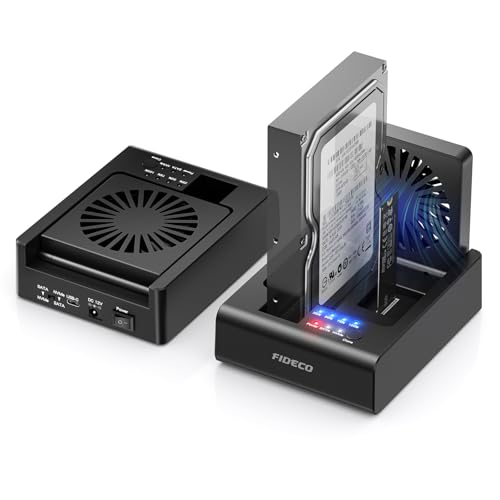
FIDECO 2-Bay NVMe & SATA Dock with Fan
Best for: cross-format cloning between NVMe and SATA drives
- Features
- Offline Clone (what this guide is about)
- Max Transfer Speed
- 10Gbps
- Host Interface
- USB 3.2 Gen 2
- Drive Interface
- PCIe NVMe (M-Key, M+B Key), SATA
- Supported Form Factors
- 2.5-inch, 3.5-inch
- Drive Bay Count
- 2-Bay
This dual-bay docking station connects one M.2 NVMe drive alongside one 2.5-inch or 3.5-inch SATA drive. It features bidirectional offline cloning, allowing transfers between NVMe and SATA in either direction without a computer. The enclosure runs at USB 3.2 Gen 2 speeds up to 10Gbps for NVMe and 5Gbps for SATA. Built-in cooling comes via an integrated foldable fan, suiting mixed drive setups.
Pros
- Bidirectional offline cloning between NVMe and SATA drives
- Accommodates 2.5-inch and 3.5-inch SATA drives alongside an M.2 NVMe slot
- Integrated foldable cooling fan
- 10Gbps USB 3.2 Gen 2 connection for NVMe and 5Gbps for SATA
Cons
- SATA transfer speed capped at 5Gbps
- Holds only one M.2 NVMe drive at a time
Good fit if
- You need to clone data between an M.2 NVMe SSD and a SATA drive.
- You want an integrated cooling fan for thermal control during operations.
- You frequently swap between 2.5-inch, 3.5-inch, and M.2 form factors.
Skip if
- You need to clone directly between two M.2 NVMe SSDs.
- You require transfer speeds higher than 10Gbps.
Verdict: FIDECO Dual-Bay NVMe and SATA Dock provides versatile cross-format cloning between M.2 NVMe and SATA drives without host PC intervention. Its integrated cooling fan maintains airflow across both bays during extended duplications.

ULXUUUN Dual-Bay 20Gbps NVMe Cloner Dock
Best for: high-speed offline cloning between dual NVMe SSDs
- Features
- Tool-Free, Offline Clone (what this guide is about)
- Max Transfer Speed
- 20Gbps
- Host Interface
- USB 3.2 Gen 2x2
- Drive Interface
- PCIe NVMe (M-Key, B+M Key)
- Supported Form Factors
- 2230, 2242, 2260, 2280, 22110
- Drive Bay Count
- Dual Bay
This ULXUUUN dual-bay docking station operates two M.2 NVMe solid-state drives simultaneously over a 20Gbps USB 3.2 Gen 2x2 interface. You can clone drives offline without a host computer using a dedicated button. It features an open-frame design with a vented baseplate, JMS586U controller, TRIM support, and a dedicated 12V/2A power adapter. It suits you if you need rapid PC-free backups strictly between two PCIe NVMe drives.
Pros
- USB 3.2 Gen 2x2 interface supports up to 20Gbps transfer rates
- Standalone one-button offline cloning requires no computer connection
- JMS586U controller supports concurrent dual-drive access, TRIM, and S.M.A.R.T.
- Includes 12V/2A power supply, 20Gbps C-to-C cable, and 10Gbps C-to-A cable
Cons
- Incompatible with M.2 SATA SSDs
- Limits drive sizing to M.2 2280 form factor
- Target drive capacity must match or exceed source drive
Good fit if
- You clone M.2 NVMe drives without using a host computer.
- You have a USB 3.2 Gen 2x2 port for 20Gbps data transfers.
- You exclusively use M-Key or B+M Key PCIe NVMe drives.
Skip if
- You need compatibility with M.2 SATA SSDs.
- You need to clone a larger source drive onto a smaller target drive.
Verdict: ULXUUUN Dual-Bay 20Gbps NVMe Cloner Dock provides rapid 20Gbps data transfers and standalone duplication for NVMe drives. Its open-frame, tool-free layout suits technicians managing 2280 PCIe SSD backups.

FIDECO 3-Bay M.2 NVMe and SATA Cloner Dock
Best for: cloning SATA drives to NVMe SSDs offline
- Features
- Tool-Free, Offline Clone (what this guide is about)
- Max Transfer Speed
- 10Gbps
- Host Interface
- USB 3.2 Gen 2
- Drive Interface
- M.2 PCIe NVMe (M/M+B Key), SATA
- Supported Form Factors
- 2.5-inch, 3.5-inch
- Drive Bay Count
- 3 bays
This 3-bay docking station accepts two M.2 NVMe SSDs and one 2.5-inch or 3.5-inch SATA drive at the same time. You can run standalone offline cloning either from NVMe to NVMe or from SATA to NVMe using a hardware toggle switch. Data transfers reach up to 10Gbps for NVMe and 5Gbps for SATA. It suits you if you migrate mixed drive formats regularly.
Pros
- Clones offline from NVMe to NVMe or 2.5"/3.5" SATA to NVMe
- Accesses two M.2 NVMe drives and one SATA drive simultaneously
- Equipped with a built-in foldable cooling fan
- Provides USB 3.2 Gen 2 transfer speeds up to 10Gbps
Cons
- Does not support offline cloning from NVMe to SATA
- SATA drive connection tops out at 5Gbps transfer speeds
Good fit if
- You need to clone an existing SATA hard drive or SSD directly onto an NVMe SSD
- You want simultaneous desktop access to both M.2 PCIe SSDs and standard SATA drives
Skip if
- You require an offline clone target that writes directly to a SATA drive
- You need transfer speeds faster than 10Gbps over USB4 or Thunderbolt
Verdict: FIDECO 3-Bay M.2 NVMe and SATA Cloner Dock delivers versatile multi-drive connectivity with standalone SATA-to-NVMe and NVMe-to-NVMe duplication. It offers a practical hardware solution when upgrading older SATA storage to modern M.2 solid-state media.
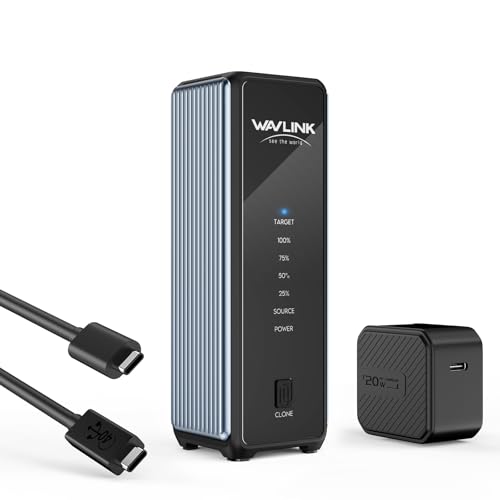
WAVLINK 40Gbps Dual-Bay NVMe Cloner
Best for: Fast 40Gbps transfers and standalone NVMe cloning
- Features
- Tool-Free, Offline Clone (what this guide is about)
- Max Transfer Speed
- 40Gbps
- Host Interface
- USB4
- Drive Interface
- PCIe NVMe (M-Key, B+M Key)
- Supported Form Factors
- 2230, 2242, 2260, 2280
- Drive Bay Count
- 2 bays
This WAVLINK dual-bay enclosure provides standalone offline cloning for M.2 NVMe drives alongside high-speed 40Gbps USB4 host connectivity. It reaches transfer speeds up to 3300MB/s read and 3000MB/s write when connected to a computer. An integrated active cooling fan and aluminum alloy body manage drive temperatures during heavy transfers. It suits you if you need fast PC data transfers alongside one-click drive duplication without a host system.
Pros
- Up to 40Gbps USB4 transfer speeds with 3300MB/s read and 3000MB/s write
- One-click offline cloning between dual M.2 NVMe bays
- Active cooling fan paired with aluminum alloy housing and vents
- Supports M-key and B+M key NVMe SSDs up to 8TB per drive
Cons
- Supports NVMe drives only, with no SATA M.2 SSD support listed
- Requires target SSD capacity to be equal to or larger than source SSD
Good fit if
- You need 40Gbps USB4 or Thunderbolt host transfer speeds.
- You want PC-free offline cloning between two NVMe M.2 drives.
- You use drives up to 8TB in 2230, 2242, 2260, or 2280 form factors.
Skip if
- You need compatibility with SATA-based M.2 SSDs.
- You plan to clone to a target drive with smaller capacity than the source.
Verdict: WAVLINK 40Gbps Dual-Bay NVMe Cloner combines high-speed 40Gbps USB4 host connectivity with push-button standalone drive duplication. Built-in active cooling and broad NVMe form-factor support make it an effective tool for high-bandwidth drive cloning.
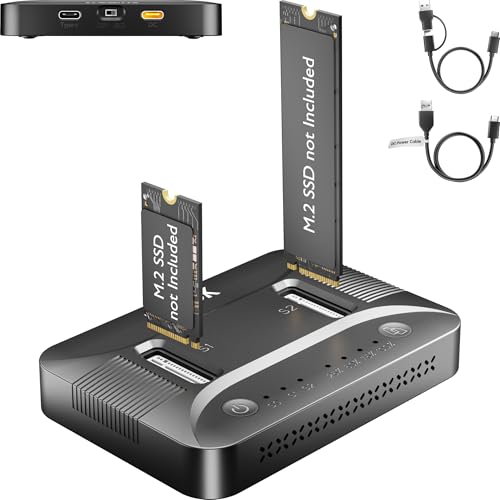
SUITOK Dual-Bay NVMe and SATA Cloner Dock
Best for: cloning mixed NVMe and SATA M.2 drives
- Features
- Offline Clone (what this guide is about)
- Max Transfer Speed
- 10Gbps
- Host Interface
- USB-C, USB 3.2 Gen 2
- Drive Interface
- M.2 NVMe (PCIe Gen 3/4), SATA
- Supported Form Factors
- 2230, 2242, 2260, 2280, 22110
- Drive Bay Count
- 2 bays
The SUITOK Dual-Bay NVMe and SATA Cloner Dock is a standalone duplicator and two-drive external enclosure. It features one-button offline cloning at up to 10Gbps over USB 3.2 Gen 2 without requiring a host computer. The tool-free slide-in bays accept M.2 NVMe and SATA drives ranging from 2230 up to 22110 form factors, supporting capacities up to 16TB total. This setup suits you if you frequently duplicate mixed drive types.
Pros
- Supports both M.2 NVMe and SATA SSDs across 2230 to 22110 lengths
- Standalone offline cloning operates without connecting to a computer
- Tool-free slide-in tray design with built-in ventilation channels
- Dual-drive enclosure mode supports up to 16TB total capacity at 10Gbps
Cons
- Transfer speed capped at 10Gbps rather than faster 20Gbps or 40Gbps protocols
- Holds only up to two M.2 drives simultaneously
Good fit if
- You need to clone or read both NVMe and SATA M.2 drives.
- You work with long 22110 form factor M.2 drives.
- You want standalone 1:1 sector-level cloning without running a computer.
Skip if
- You need transfer speeds faster than 10Gbps USB 3.2 Gen 2.
- You require a multi-bay dock that clones three or four drives at once.
Verdict: SUITOK Dual-Bay NVMe and SATA Cloner Dock delivers versatile standalone cloning and external storage across both NVMe and SATA protocols. Its support for sizes up to 22110 makes it a flexible tool-free duplicator.

ORICO 4-Bay Aluminum 40Gbps NVMe Cloner
Best for: four-bay NVMe offline cloning and USB4 transfers
- Features
- Offline Clone (what this guide is about)
- Max Transfer Speed
- 40Gbps
- Host Interface
- USB4
- Supported Form Factors
- 2230, 2242, 2260, 2280, 22110
- Drive Bay Count
- 4 bays
- Cooling System
- Aluminum alloy heat sink
This ORICO docking station provides four M.2 NVMe bays inside a CNC aluminum alloy body. It delivers 40Gbps USB4 connectivity to your computer and supports one-click offline cloning between drives without a host system. Each slot accepts sizes from 2230 up to 22110 at capacities up to 8TB. It suits you if you handle multi-drive NVMe backups, high-speed media transfers, or batch drive duplication without needing SATA drive support.
Pros
- USB4 interface with up to 40Gbps total bandwidth
- Four M.2 slots with standalone offline cloning
- Supports NVMe drive sizes from 2230 to 22110
- CNC aluminum alloy housing acts as passive heatsink
- Accommodates up to 8TB capacity per drive
Cons
- Does not support M.2 SATA SSDs
- Single-disk transfer speed caps at 20Gbps during four-drive operation
Good fit if
- You need standalone offline cloning across four M.2 NVMe drives.
- You work with long 22110 form factor NVMe drives up to 8TB each.
- You want 40Gbps USB4 transfer speeds in a solid aluminum dock.
Skip if
- You need to clone or read SATA-based M.2 drives.
- Your target drive has less capacity than your source drive.
Verdict: ORICO 4-Bay Aluminum 40Gbps NVMe Cloner delivers standalone four-drive duplication and high-bandwidth USB4 transfers in a solid aluminum shell. It is a capable workstation tool if all your drives run on the NVMe protocol.

SSK Dual-Bay NVMe and SATA M.2 SSD Cloner Dock
Best for: standalone cloning between same-protocol M.2 drives
- Features
- Offline Clone (what this guide is about)
- Max Transfer Speed
- 10Gbps
- Host Interface
- USB 3.2 Gen 2
- Drive Interface
- NVMe, SATA
- Drive Bay Count
- 2 bays
- Cooling System
- Open-frame
View on Amazon: SSK Dual-Bay NVMe and SATA M.2 SSD Cloner Dock
This SSK dual-bay dock is an offline cloner for M.2 NVMe and SATA drives. It uses an RTL9210CDP chip and connects via USB 3.2 Gen 2 at up to 10Gbps, with SATA speeds reaching 6Gbps. The open-frame design allows airflow, while firmware supports UASP, TRIM, and S.M.A.R.T. data. You get standalone one-button cloning between matching protocols without using a computer.
Pros
- Standalone one-key offline cloning without a host computer
- Supports both M.2 NVMe (10Gbps) and SATA (6Gbps) drives
- RTL9210CDP controller with UASP, TRIM, and S.M.A.R.T. support
- Open-frame design for passive drive airflow
Cons
- Offline cloning requires matching protocols (NVMe to NVMe or SATA to SATA only)
- Open-frame construction leaves installed SSDs exposed to touch during operation
- Transfers cap at 10Gbps for NVMe and 6Gbps for SATA
Good fit if
- You need standalone offline cloning between identical protocol M.2 drives.
- You want a dual-bay dock supporting both NVMe and SATA M.2 form factors.
- You require TRIM and S.M.A.R.T. monitoring over USB 3.2 Gen 2.
Skip if
- You need to clone cross-protocol from NVMe to SATA or SATA to NVMe.
- You prefer an enclosed chassis that shields hot drives during operation.
- You require transfer speeds higher than 10Gbps.
Verdict: SSK Dual-Bay NVMe and SATA M.2 SSD Cloner Dock offers straightforward standalone cloning and dual-protocol USB 3.2 Gen 2 dock connectivity. It is a reliable option as long as your offline cloning tasks stay within the same drive protocol.
Specifications side by side
| Spec | Sokiwi Dual-Bay M.2 NVMe Clone Enclosure | GODO Dual-Bay NVMe and SATA Clone Dock | WAVLINK Dual-Bay 20Gbps NVMe Cloner | MAIWO 4-Bay 40Gbps NVMe Cloner Enclosure | NEWQ Dual-Bay 20Gbps RAID NVMe Enclosure | MAIWO Dual-Bay NVMe & SATA SSD Cloner | Pefishop Dual-Bay NVMe Cloner | Rosewill Dual-Bay NVMe Cloner Dock | FIDECO 2-Bay NVMe & SATA Dock with Fan | ULXUUUN Dual-Bay 20Gbps NVMe Cloner Dock | FIDECO 3-Bay M.2 NVMe and SATA Cloner Dock | WAVLINK 40Gbps Dual-Bay NVMe Cloner | SUITOK Dual-Bay NVMe and SATA Cloner Dock | ORICO 4-Bay Aluminum 40Gbps NVMe Cloner | SSK Dual-Bay NVMe and SATA M.2 SSD Cloner Dock |
|---|---|---|---|---|---|---|---|---|---|---|---|---|---|---|---|
| Max Transfer Speed | 10Gbps | 10Gbps | 20Gbps | 40Gbps | 20Gbps | 10Gbps | 10Gbps | 20Gbps | 10Gbps | 20Gbps | 10Gbps | 40Gbps | 10Gbps | 40Gbps | 10Gbps |
| Host Interface | USB 3.2 Gen 2 | USB 3.1 Gen 2 Type-C | USB-C | USB4, Thunderbolt 4/3 | USB-C | USB 3.2 Gen 2 | USB 3.2 Gen 2x2 | USB 3.2 Gen 2x2 | USB 3.2 Gen 2 | USB 3.2 Gen 2x2 | USB 3.2 Gen 2 | USB4 | USB-C, USB 3.2 Gen 2 | USB4 | USB 3.2 Gen 2 |
| Drive Interface | NVMe M.2 | M.2 NVMe, SATA (M Key, B+M Key) | PCIe NVMe (M and B+M keys) | not specified | PCIe NVMe | M.2 NVMe & SATA (M Key, B+M Key) | PCIe NVMe M Key, B+M Key | PCIe NVMe (M-Key, B+M Key) | PCIe NVMe (M-Key, M+B Key), SATA | PCIe NVMe (M-Key, B+M Key) | M.2 PCIe NVMe (M/M+B Key), SATA | PCIe NVMe (M-Key, B+M Key) | M.2 NVMe (PCIe Gen 3/4), SATA | not specified | NVMe, SATA |
| Supported Form Factors | 2230, 2242, 2260, 2280 | M.2 2230, 2242, 2260, 2280, 22110 | 2280/2260/2242/2230 | 2230, 2242, 2260, 2280 | 2280 | not specified | 2230 to 22110 | not specified | 2.5-inch, 3.5-inch | 2230, 2242, 2260, 2280, 22110 | 2.5-inch, 3.5-inch | 2230, 2242, 2260, 2280 | 2230, 2242, 2260, 2280, 22110 | 2230, 2242, 2260, 2280, 22110 | not specified |
| Drive Bay Count | 2 bays | 2 bays | 2 bays | 4 bays | 2 bays | Dual-Bay | 2 bays | 2 bays | 2-Bay | Dual Bay | 3 bays | 2 bays | 2 bays | 4 bays | 2 bays |
| Cooling System | Built-in cooling fan | Aluminum | Silicone thermal pads | Built-in cooling fan, aluminum alloy | Aluminum casing | not specified | not specified | not specified | Foldable cooling fan | Open-frame, vented baseplate | Foldable cooling fan | Active cooling fan, aluminum housing | Built-in ventilation channels | Aluminum alloy heat sink | Open-frame |
| Maximum Capacity | not specified | 4TB | 16TB (8TB per drive) | 32TB | 16TB | not specified | 2x8TB | not specified | not specified | not specified | not specified | 8TB per drive | 16TB | not specified | not specified |
| Installation Style | Tool-Free | Tool Free | Tool-Free | Tool-free | Tool-free | not specified | Tool-Free | Tool-free | not specified | Tool-Free | Tool-Free | Tool-Free | Tool-free | Tool-free | not specified |
| Interface | NVMe | SATA III | NVMe | NVMe | NVMe | SATA III | NVMe | not specified | SATA III | NVMe | SATA III | NVMe | SATA III | NVMe | SATA III |
| Form Factor | M.2 | M.2 | M.2 2280 | M.2 | M.2 2280 | M.2 | M.2 | M.2 | 2.5 Inch | M.2 2280 | 2.5 Inch | M.2 2280 | M.2 | M.2 2280 | M.2 |
| Cooling | not specified | not specified | not specified | Cooling Fan | not specified | not specified | not specified | not specified | Cooling Fan | not specified | Cooling Fan | Cooling Fan | not specified | not specified | not specified |
| Transfer Speed | 10Gbps | not specified | 20Gbps | 40Gbps | 20Gbps | not specified | 10Gbps | 20Gbps | not specified | 20Gbps | not specified | 40Gbps | 10Gbps | 40Gbps | not specified |
| Features | Offline Clone | Tool-Free, Offline Clone | Tool-Free, Offline Clone | Offline Clone | Offline Clone | Offline Clone | Offline Clone | Tool-Free, Offline Clone | Offline Clone | Tool-Free, Offline Clone | Tool-Free, Offline Clone | Tool-Free, Offline Clone | Offline Clone | Offline Clone | Offline Clone |
| Bay Count | not specified | Dual-Bay | Dual-Bay | not specified | Dual-Bay | Dual-Bay | Dual-Bay | Dual-Bay | not specified | Dual-Bay | not specified | not specified | Dual-Bay | not specified | Dual-Bay |
| Material | not specified | not specified | not specified | not specified | not specified | not specified | not specified | not specified | not specified | not specified | not specified | not specified | not specified | Aluminum | not specified |
| Weight | 13.8 ounces | not specified | 1.01 pounds | 7.05 ounces | 1.01 pounds | not specified | not specified | 13.6 ounces | 1.28 pounds | not specified | not specified | not specified | 3.58 ounces | not specified | 3.17 ounces |
| Dimensions | not specified | 3.14 × 0.69 × 0.69 inches | 5.91 × 3.94 × 2.36 inches | 5.71 × 5.71 × 1.26 inches | not specified | 4 × 2.5 × 0.5 inches | not specified | 6 × 5 × 2.75 inches | not specified | not specified | not specified | 1.6 × 1.6 × 1.7 inches | 3.87 × 2.68 × 0.71 inches | not specified | 2.83 × 2.83 × 0.86 inches |
| Size | 2230/2242/2260/2280 | not specified | not specified | not specified | not specified | not specified | not specified | 20 Gbps Dual Bay Cloner | 2-Bay | not specified | 3-Bay | not specified | 3.87 x 2.68 x 0.71 inches | not specified | 10Gbps NVMe & 6Gbps SATA |
| Color | Star Black | Black | Silver | not specified | Space Blue | Gray | Grey | black | Black | Black | Black | Black | Black | silver | not specified |
| Model | SKUD1001 | DK01-NVMe/SATA | NVMe + NVMe | K2024P | NQ-RD-01 | K2023CL | not specified | RS-N2-CL | MS01 | not specified | MS02 | 40Gbps Offline Cloning | STK07 Pro 10Gbps Dual Bay M.2 Cloner | ORICO-M440-SV-BP | DK204 |
If you need a dedicated system to receive your cloned drive, examine the best mini PCs with 128GB SSD to evaluate their storage interfaces.
How to Choose an Offline SSD Cloner
-
Compare Host Transfer Speeds
Look at the host transfer speed if you plan to use the cloner as external storage. Models offer 10Gbps, 20Gbps, or 40Gbps specifications. A 10Gbps dock works well for general file backups and standard USB ports. A 20Gbps or 40Gbps dock suits users moving very large files across compatible high-speed ports. The WAVLINK 40Gbps Dual-Bay NVMe Cloner provides 40Gbps bandwidth for rapid computer transfers. Match the cloner speed rating to your computer port capabilities to prevent data bottlenecks when using the device online.
-
Evaluate Bay Count Capabilities
Check the bay count before buying to suit your volume requirements. Most cloners provide two bays designed for standard one-to-one drive duplication. If you manage multiple drive deployments, a four-bay unit allows you to write one source drive to three targets simultaneously. The MAIWO 4-Bay 40Gbps NVMe Cloner Enclosure features a 1-to-3 clone architecture for multi-drive workflows. Dual-bay docks keep the footprint compact for single copies, whereas multi-bay units streamline batch duplication tasks without requiring separate clone cycles for each individual drive.
-
Verify Supported Drive Lengths
Inspect the physical M.2 size compatibility list for each slot. Many enclosures limit drive installation strictly to standard 2280 form factor modules. If you work with varied hardware like compact 2230 handheld SSDs or longer enterprise 22110 cards, ensure the slots accommodate those physical dimensions. The Pefishop Dual-Bay NVMe Cloner supports sizes up to 22110. Checking size specifications prevents physical fit issues before mounting drives, especially when duplicating cards removed from compact laptops, gaming handhelds, or enterprise server blades.
-
Check Active Cooling Specs
Check the cooling specifications if you run long, continuous drive cloning sessions. SSDs generate heat under sustained read and write operations. While open-dock designs rely on passive air exposure, models with an integrated cooling fan actively circulate air across the drive controllers. The FIDECO 2-Bay NVMe & SATA Dock with Fan includes an active cooling fan to maintain steady airflow across both bays. Select active cooling if you clone high-capacity drives that take extended periods to finish duplicating.
-
Look for Hardware RAID
Determine whether you need drive array functionality beyond basic offline cloning. Certain multi-bay units include built-in hardware RAID controllers alongside standalone cloning switches. This allows you to configure drives in redundant or combined storage modes when connected to your operating system. The NEWQ Dual-Bay 20Gbps RAID NVMe Enclosure incorporates hardware RAID support alongside offline cloning. If you want a dual-purpose unit that provides daily storage redundancy as well as offline duplication, check the listing for explicit hardware RAID specifications.
-
Assess Drive Installation Mechanisms
Consider how frequently you plan to swap solid-state drives in the enclosure bays. Standard enclosures sometimes require tiny screws or specialized tools to secure drives. If you frequently handle different media or test SSDs, seek models listed with tool-free features. The Rosewill Dual-Bay NVMe Cloner Dock provides tool-free drive swapping for convenient media changes. Tool-free designs let you insert and release drives quickly without screwdrivers, speeding up repetitive cloning workflows across multiple storage devices.
Frequently asked questions
Can an offline SSD cloner duplicate drives without an operating system?
Yes, offline SSD cloners operate entirely without an operating system or computer connection. The hardware dock copies data block by block directly from the source drive to the target drive. For example, units like the Rosewill Dual-Bay NVMe Cloner Dock and Pefishop Dual-Bay NVMe Cloner duplicate media independently using built-in offline cloning hardware.
Can you clone a larger SSD to a smaller SSD using an offline cloner?
No, offline SSD cloning hardware requires the target drive to have equal or greater capacity than the source drive. Standalone duplicators perform raw sector-level copying without dynamic partition shrinking. If your destination M.2 drive has less total storage space than your source SSD, the enclosure cannot complete the standalone duplication process.
Why do some offline SSD cloners include integrated cooling fans?
Continuous sector copying across multiple high-speed drives generates sustained heat during standalone operation. Built-in cooling fans maintain airflow across the drives to help manage operating temperatures. Models such as the Sokiwi Dual-Bay M.2 NVMe Clone Enclosure, FIDECO 2-Bay dock, and MAIWO 4-Bay cloner feature active cooling fans to circulate air around installed drives.
Can you clone to multiple target drives at the same time?
Yes, multi-bay cloners can duplicate data across several destination drives simultaneously. The MAIWO 4-Bay 40Gbps NVMe Cloner provides 1-to-3 offline cloning, copying one source NVMe SSD to three target NVMe drives at once. The ORICO 4-Bay Aluminum NVMe Cloner also features a four-bay layout for users needing multi-drive standalone duplication.
Can you clone a 2.5-inch SATA drive with an offline cloner?
Yes, select offline cloning docks accommodate 2.5-inch SATA drives alongside M.2 media. The FIDECO 2-Bay NVMe & SATA Dock with Fan and the FIDECO 3-Bay Cloner Dock both feature a 2.5 Inch SATA III form factor. These units allow you to duplicate legacy 2.5-inch SATA drives or clone between SATA and M.2 NVMe SSDs without a computer.
Do offline clone enclosures support hardware RAID modes?
Yes, specific dual-bay and multi-bay cloner enclosures include hardware RAID functionality alongside offline duplication. The NEWQ Dual-Bay 20Gbps RAID NVMe Enclosure features built-in hardware RAID setups in a dual-bay chassis. Additionally, the MAIWO 4-Bay USB4 cloner provides flexible RAID options, allowing you to configure redundant storage when you finish cloning drives.
Does offline cloning overwrite existing files on the target drive?
Yes, offline cloning completely overwrites all pre-existing data stored on the destination SSD. Standalone cloners execute direct sector-by-sector hardware duplication from the source bay to the target bay. You must back up any essential files on the target drive prior to starting the clone cycle, because the process writes over existing partition structures completely.