TEAMGROUP vs Transcend: Nvme SSDs Compared by Specs
As an Amazon Associate we earn from qualifying purchases. Links on this page are affiliate links.
This TEAMGROUP vs transcend nvme SSD comparison looks at two SATA-based M.2 drives. Both use SATA III 6Gb/s interfaces and SLC cache technology to boost performance. The main difference lies in their physical form factors and capacities. One offers a standard 2280 size with more storage, while the other provides a compact 2242 form factor. You will see how these specs affect your choice for different system builds.
Key differences
| Aspect | TEAMGROUP MS30 256GB M.2 SATA SSD | Transcend 120GB M.2 2242 SATA SSD |
|---|---|---|
| Form Factor | M.2 2280 | M.2 2242 |
| Max Read Speed | 500 MB/s | 560 MB/s |
| Max Write Speed | 400 MB/s | 500 MB/s |
| Storage Capacity | 256GB | 120GB |
| NAND Type | 3D TLC | 3D TLC |
Which one should you choose?
Choose TEAMGROUP MS30 256GB M.2 SATA SSD if
- You need a larger 256GB capacity for your operating system and applications.
- Your motherboard requires the standard M.2 2280 form factor.
- You prefer a drive with Intel Smart Response Technology support.
Choose Transcend 120GB M.2 2242 SATA SSD if
- You are building in a compact chassis that only fits M.2 2242 drives.
- You want slightly faster sequential read and write speeds.
- You need a smaller 120GB drive for basic storage tasks.
Verdict: Choose the TEAMGROUP MS30 if you need more storage space and a standard size. Pick the Transcend MTS420S if your system requires a smaller 2242 form factor or if you prioritize the highest listed sequential speeds. Both drives offer reliable SATA performance with SLC caching.
TEAMGROUP vs Transcend SSD Specs
Transfer Speed
When you look at raw performance numbers, the Transcend drive takes a slight lead. It offers a maximum read speed of 560 MB/s and a write speed of 500 MB/s. The TEAMGROUP MS30 is rated for 500 MB/s reads and 400 MB/s writes. Both drives use the SATA III 6Gb/s interface, which caps theoretical bandwidth at 600 MB/s. In practice, these speeds are sufficient for everyday tasks like booting your operating system, loading applications, and transferring large files. The difference between 500 and 560 MB/s is noticeable in benchmarks but often feels similar in daily use. If maximum throughput is your priority, the Transcend model provides a modest advantage in both reading and writing data.
Form Factor
Physical size is the most critical difference between these two drives. The TEAMGROUP MS30 uses the M.2 2280 form factor, which measures 80mm in length. This is the standard size for most desktop motherboards and many modern laptops. The Transcend MTS420S uses the M.2 2242 form factor, measuring only 42mm in length. The 2242 size is common in compact mini-PCs, ultrabooks, and industrial applications where space is limited. You must check your device’s M.2 slot to ensure it supports the length you choose. A 2242 drive will not fit in a slot designed only for 2280 modules. Choose the form factor that matches your hardware constraints.
Storage Capacity
The TEAMGROUP MS30 offers a storage capacity of 256GB. The Transcend MTS420S provides 120GB of space. Both capacities are on the lower end of the current market. The 256GB option from TEAMGROUP gives you roughly twice the room for your operating system, applications, and documents. The 120GB Transcend drive fills up quickly with modern software and media files. If you plan to store games, video projects, or large archives, you will likely need to manage space carefully on the Transcend unit. For a general-purpose system drive, the larger capacity of the TEAMGROUP drive offers more flexibility and longevity before you need to upgrade.
Cache Type
Both drives utilize SLC cache technology to improve performance. This feature creates a high-speed buffer using single-level cell memory dynamics to handle burst writes and reads more efficiently. This helps maintain speed when transferring large files or when the drive is nearly full. Both the TEAMGROUP MS30 and the Transcend MTS420S advertise this same caching mechanism. Since both products rely on this technology to boost their SATA III speeds, neither has a distinct advantage in this specific area. The actual performance benefit depends on how the drive manages the cache during sustained workloads. For typical desktop usage, both should handle temporary file spikes similarly.
NAND Type
The TEAMGROUP MS30 explicitly lists its NAND type as 3D TLC NAND. This means it uses triple-level cell memory arranged in vertical layers, which typically offers higher densities and improved endurance compared to older planar technologies. The Transcend MTS420S features also mention it is built using premium 3D TLC NAND flash memory chips. Since both manufacturers specify 3D TLC technology, they are using similar underlying storage media. This type of NAND is standard for consumer SSDs, offering a balance of cost, performance, and reliability. There is no significant difference in the NAND technology description between the two products based on the available data.
Which M.2 SATA SSD fits your needs
Users needing larger storage capacity
The TEAMGROUP MS30 offers 256GB of storage, which is double the capacity of the Transcend drive. This extra space allows you to store more files, applications, and games without running out of room quickly. The higher capacity makes it a more practical choice for daily use where data accumulation is expected.
Those with limited motherboard space
The Transcend MTS420S uses an M.2 2242 form factor, which is shorter than the standard 2280 size. This compact physical footprint fits into smaller laptops or compact desktops where a longer drive would not fit. If your device only supports the shorter 42mm length, this drive is the only compatible option.
Buyers prioritizing maximum transfer speeds
The Transcend drive features a higher maximum read speed of 560 MB/s compared to the TEAMGROUP's 500 MB/s. It also offers a faster write speed of 500 MB/s versus 400 MB/s. These higher numbers mean faster file transfers and quicker system response times when moving large amounts of data.
The products compared

TEAMGROUP MS30 256GB M.2 SATA SSD
Best for: basic storage upgrades for older systems
- Storage Capacity
- 256GB
- Interface
- SATA III 6Gb/s
- Max Read Speed
- 500 MB/s
- Max Write Speed
- 400 MB/s
- Cache Type
- SLC Cache
- Form Factor
- M.2 2280
View on Amazon: TEAMGROUP MS30 256GB M.2 SATA SSD Affiliate link
This 256GB M.2 2280 SSD uses a SATA III 6Gb/s interface with TLC NAND and SLC caching. You get sequential reads up to 500 MB/s and writes up to 400 MB/s. It supports Intel Smart Response Technology and standard maintenance commands like TRIM and wear leveling. The drive fits laptops and desktops. It is a practical option for users needing reliable storage expansion without the cost of NVMe.
Pros
- SATA III 6Gb/s interface for broad compatibility
- Read speeds up to 500 MB/s
- SLC Cache technology for improved performance
- Supports Intel Smart Response Technology
- 3-year limited warranty
Cons
- SATA interface limits speed compared to NVMe
- 256GB capacity is entry-level
- No included software management suite listed
Good fit if
- You need a drop-in upgrade for older laptops
- You want to add cache to an HDD system
- You prefer standard SATA compatibility over NVMe
Skip if
- You require high-speed NVMe transfers
- You need more than 256GB of storage
- You are building a modern gaming PC
Verdict: TEAMGROUP MS30 256GB SATA SSD delivers standard SATA performance for basic storage tasks. It suits users upgrading older systems who do not need NVMe speeds.
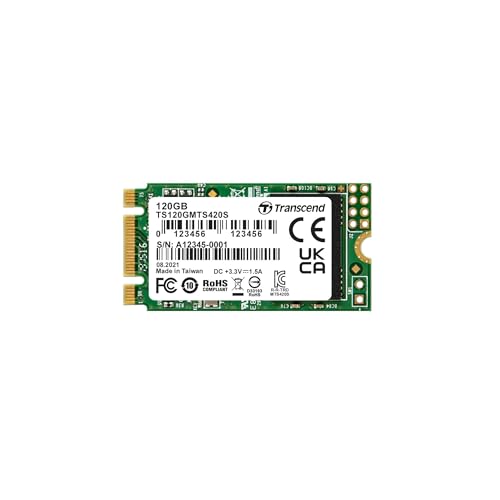
Transcend 120GB M.2 2242 SATA SSD
Best for: compact systems needing small M.2 SATA storage
- Storage Capacity
- 120GB
- Interface
- SATA III 6GB/s
- Max Read Speed
- 560MB/sec
- Max Write Speed
- 500MB/sec
- Cache Type
- SLC Cache
- Form Factor
- M.2 2242
View on Amazon: Transcend 120GB M.2 2242 SATA SSD Affiliate link
The Transcend MTS420S is a 120GB M.2 2242 SATA SSD designed for compact systems. It features a SATA III 6Gb/s interface with read speeds up to 560MB/sec and write speeds up to 500MB/sec. The drive uses 3D TLC NAND with an SLC cache for improved performance. It supports Trim, s.M.A.R.T., and NCQ commands. This small form factor suits users needing storage for tight spaces.
Pros
- M.2 2242 form factor fits compact builds
- Read speeds up to 560MB/sec
- SLC cache improves sustained performance
- 3-year warranty coverage
Cons
- 120GB capacity is limited for modern needs
- SATA III interface caps speeds below NVMe standards
- 2242 size requires specific motherboard support
Good fit if
- You need a small M.2 2242 drive for a mini PC or laptop
- You require SATA III speeds for basic storage upgrades
- You want a drive with an SLC cache for better responsiveness
Skip if
- You need high-speed NVMe performance for gaming or video editing
- You require large storage capacity beyond 120GB
- Your motherboard only supports M.2 2280 form factors
Verdict: Transcend MTS420S 120GB M.2 2242 SATA SSD is a compact storage solution for users with space constraints. It offers reliable SATA III speeds and an SLC cache, making it suitable for basic computing tasks in small form factor systems.
Specifications side by side
| Spec | TEAMGROUP MS30 256GB M.2 SATA SSD | Transcend 120GB M.2 2242 SATA SSD |
|---|---|---|
| Storage Capacity | 256GB | 120GB |
| Interface | SATA III 6Gb/s | SATA III 6GB/s |
| Max Read Speed | 500 MB/s | 560MB/sec |
| Max Write Speed | 400 MB/s | 500MB/sec |
| Cache Type | SLC Cache | SLC Cache |
| Form Factor | M.2 2280 | M.2 2242 |
| Compatibility | Laptop, Desktop | Laptop, Desktop |
| NAND Type | 3D NAND, TLC | not stated |
| Size | 256GB | 120GB |
| Dimensions | 0.87 × 3.15 × 0.14 inches | 0.87 × 0.15 × 3.15 inches |
| Weight | 0.35 ounces | not stated |
| Model | TM8PS7256G0C101 | TS120GMTS420S |
| Color | not stated | Multicoloured |
Frequently asked questions
Is the Transcend 120GB M.2 2242 SATA SSD compatible with my laptop?
Yes, the Transcend MTS420S is designed for compact systems with space constraints. Its M.2 2242 form factor allows it to fit into smaller slots than standard drives. This makes it a reliable choice for users who need SATA III speeds in a small form factor system without taking up much room.
Does the TEAMGROUP MS30 use SLC cache technology?
Yes, the TEAMGROUP MS30 includes an SLC cache to boost performance. It also uses 3D TLC NAND for storage. This combination helps deliver standard SATA speeds, making it suitable for basic storage tasks and upgrading older systems that do not require the higher speeds of NVMe drives.
What is the difference in form factor between these two SSDs?
The main physical difference is their size. The TEAMGROUP MS30 uses a standard M.2 2280 form factor. The Transcend drive uses a smaller M.2 2242 form factor. This means the Transcend unit is shorter, making it better for devices with limited space, while the TEAMGROUP drive fits standard slots.
Can I use the TEAMGROUP MS30 in a desktop computer?
Yes, the TEAMGROUP MS30 is compatible with both laptops and desktops. It connects via the SATA III interface, which is widely supported. This drive delivers standard SATA performance, making it a practical option for users upgrading older systems who need reliable storage for basic computing tasks without needing NVMe speeds.
How much storage does the Transcend M.2 2242 SATA SSD offer?
The Transcend drive offers 120GB of storage capacity. This is half the capacity of the competing TEAMGROUP model. It provides reliable SATA III speeds and uses an SLC cache to help maintain performance during basic computing tasks, making it a compact solution for users who need smaller storage volumes.
Which drive is better for older systems that need a storage upgrade?
The TEAMGROUP MS30 is ideal for upgrading older systems. It delivers standard SATA performance suitable for basic storage tasks. It offers 256GB of space, which is double the capacity of the Transcend option. This extra storage allows you to keep more files and applications without running out of space on your drive.