2.5 Inch vs M.2 SSD Docking Stations in 2026: Key Differences
As an Amazon Associate we earn from qualifying purchases. Links on this page are affiliate links.
Choosing between a 25 inch vs m2 SSD docking station depends on your drive inventory. Both SABRENT units offer tool-free access and active cooling for sustained transfers. The primary difference lies in form factor and interface. One supports traditional 2.5-inch SATA drives with a four-bay layout. The other handles M.2 NVMe sticks with dual-bay cloning. Your choice hinges on whether you prioritize capacity or speed.
Key differences
| Aspect | SABRENT 4-Bay 2.5-Inch SATA SSD Dock with Fan | SABRENT Dual-Bay NVMe Cloner Dock |
|---|---|---|
| Form Factor | 2.5-inch SATA | M.2 NVMe |
| Bay Count | 4 bays | 2 bays |
| Transfer Speed | 5Gbps | 10Gbps |
| Cloning | Not listed | One-button offline clone |
| Host Interface | USB 3.0 | USB-C |
Which one should you choose?
Choose SABRENT 4-Bay 2.5-Inch SATA SSD Dock with Fan if
- You need to manage four 2.5-inch SATA drives simultaneously.
- You want a larger footprint that supports high-capacity 16TB drives.
- You prefer a fan that can be switched off to reduce noise.
Choose SABRENT Dual-Bay NVMe Cloner Dock if
- You require fast 10Gbps transfers via USB-C.
- You need to clone NVMe drives without a computer.
- You want a compact, lightweight unit for portability.
Verdict: The four-bay SATA dock suits users with large collections of traditional drives who value capacity. The dual-bay NVMe dock is better for those needing rapid data movement and offline cloning. Select the unit that matches the physical form of your existing SSDs.
Form Factor and Interface Comparison
Form Factor
Product A supports 2.5-inch SATA SSDs and HDDs, accommodating drives up to 12.5mm in thickness. This standard form factor is common in laptops and older desktops. Product B accepts M.2 NVMe SSDs in 2230, 2242, 2260, and 2280 lengths. M.2 drives are smaller and typically faster than their 2.5-inch counterparts. If you have a collection of traditional 2.5-inch drives, Product A is the only choice. If you work with modern M.2 sticks, Product B is required. They serve different physical drive types.
Transfer Speed
Product A uses a USB 3.0 interface, delivering transfer speeds up to 5Gbps. This is sufficient for most SATA SSDs, which are limited by the SATA III interface anyway. Product B offers a USB 3.2 connection with speeds up to 10Gbps. This doubled bandwidth better suits the high throughput potential of NVMe drives. If you prioritize maximum data movement rates, Product B provides a faster connection. For standard SATA workloads, Product A’s speed is adequate.
Bay Count
Product A features four bays, allowing you to dock up to four 2.5-inch drives simultaneously. It supports up to 4x 16TB capacity, making it ideal for bulk storage management. Product B has two bays, designed for dual-drive operations like cloning or dual-access. It handles two M.2 NVMe drives at once. If you need to manage a large inventory of drives at once, Product A offers more slots. If you only need to work with two drives, Product B is compact.
Cloning Capability
Product B includes an offline cloning feature. You can copy one NVMe SSD to another with a single button press, requiring no computer, software, or drivers. Product A does not list any cloning functionality in its specifications. It focuses on standard plug-and-play access for Windows, macOS, and Linux. If you frequently need to duplicate drives without a PC, Product B offers a distinct advantage. Product A is strictly for data access and transfer.
Compatibility
Product A works with 2.5-inch SATA SSDs and HDDs. It does not support RAID or 15mm thick drives. Product B is exclusive to PCIe NVMe M.2 SSDs. It explicitly does not support M.2 SATA or AHCI SSDs. If you have mixed drives, including traditional hard drives, Product A is versatile. If you only use modern NVMe sticks, Product B is specialized. Ensure your M.2 drive is NVMe before choosing Product B, as SATA M.2 drives will not be recognized.
Which docking station fits your workflow
Users with multiple 2.5-inch SATA drives
Product A supports four 2.5-inch SATA SSDs or HDDs simultaneously. You get 5Gbps transfer speeds via USB 3.0. The built-in fan ensures reliability during long sessions. It handles drives up to 16TB each. This makes it ideal for managing a large collection of standard laptop or desktop drives without needing a PC for every swap.
Administrators needing offline drive duplication
Product B offers one-button offline cloning between two NVMe drives. You do not need a computer or software to duplicate data. It accepts various M.2 sizes like 2230 and 2280. The 10Gbps USB-C interface provides faster throughput for modern SSDs. This feature saves time when you need exact copies of large volumes quickly.
Creators requiring high-speed dual access
Product B allows reading and writing to both NVMe drives at once when connected to a host. The aluminum body and fan prevent thermal throttling during sustained transfers. You get 10Gbps speeds over USB-C, which is double the speed of Product A. This setup supports efficient workflows where you move large files between two fast drives simultaneously.
Quick picks
| # | Product | Best for | Price |
|---|---|---|---|
| 1 | SABRENT 4-Bay 2.5-Inch SATA SSD Dock with Fan | managing multiple 2.5-inch SATA drives | Check price of SABRENT 4-Bay 2.5-Inch SATA SSD Dock with Fan on Amazon |
| 2 | SABRENT Dual-Bay NVMe Cloner Dock | Cloning and managing dual NVMe drives | Check price of SABRENT Dual-Bay NVMe Cloner Dock on Amazon |
The products compared
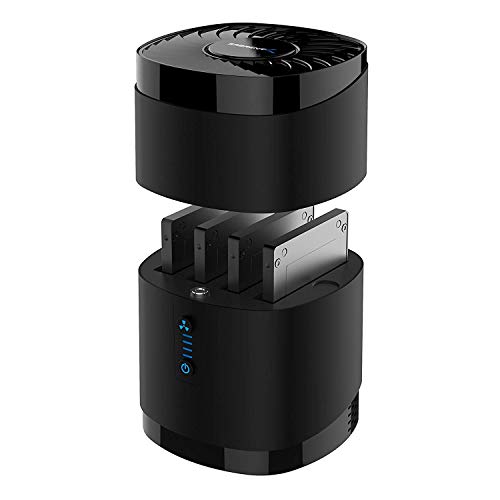
SABRENT 4-Bay 2.5-Inch SATA SSD Dock with Fan
Best for: managing multiple 2.5-inch SATA drives
- Form Factor
- 2.5 Inch (what this guide is about)
- Transfer Speed
- 5Gbps
- Supported Drive Types
- 2.5-inch SATA SSD/HDD
- Bay Count
- 4
- Maximum Capacity
- Up to 4x 16TB
- Cooling Type
- Built-in fan
View on Amazon: SABRENT 4-Bay 2.5-Inch SATA SSD Dock with Fan Affiliate link
This docking station holds four 2.5-inch SATA drives via a USB 3.0 interface. It supports transfer speeds up to 5Gbps and capacities of up to 16TB per drive. The unit includes a built-in fan for cooling and tool-free magnetic covers for easy access. It is designed for continuous 24/7 operation and works with Windows, macOS, and Linux without extra drivers.
Pros
- Supports up to four 2.5-inch SATA SSDs or HDDs
- USB 3.0 interface delivers up to 5Gbps transfer speeds
- Built-in cooling fan ensures long-term reliability
- Tool-free magnetic covers allow quick drive swaps
Cons
- Limited to USB 3.0 speeds, which is slower than USB-C 10Gbps options
- Not compatible with 15mm thick drives
- Does not support RAID configurations
Good fit if
- You need to manage multiple 2.5-inch SATA drives simultaneously
- You prefer tool-free access for frequent drive swapping
- You require a dock for continuous 24/7 operation
Skip if
- You need to dock M.2 NVMe drives
- You require transfer speeds faster than 5Gbps
- You want to use 15mm thick drives
Verdict: Sabrent 4-Bay 2.5 Inch SATA Dock is a practical solution for users who need to handle multiple 2.5-inch SATA drives at once. It fits those who value tool-free access and steady cooling over raw speed.

SABRENT Dual-Bay NVMe Cloner Dock
Best for: Cloning and managing dual NVMe drives
- Transfer Speed
- 10Gbps
- Supported Drive Types
- PCIe NVMe M.2 SSD
- Bay Count
- 2
- Offline Cloning
- One-button offline clone
- Supported M.2 Sizes
- 2230, 2242, 2260, 2280
- Cooling Type
- Aluminum body, built-in fan
View on Amazon: SABRENT Dual-Bay NVMe Cloner Dock Affiliate link
This dock handles two PCIe NVMe M.2 SSDs in 2230, 2242, 2260, or 2280 sizes. It supports offline cloning without a computer and offers USB-C speeds up to 10Gbps. The aluminum body and built-in fan manage heat during sustained transfers. You can read and write to both drives simultaneously when connected to a host. It requires a power adapter for operation.
Pros
- One-button offline cloning without a PC
- USB-C interface with up to 10Gbps transfer speeds
- Supports 2230, 2242, 2260, and 2280 NVMe drives
- Aluminum chassis with a built-in cooling fan
Cons
- Does not support M.2 SATA or AHCI SSDs
- Built-in fan runs continuously when powered
- Requires external 5V/4A power adapter
Good fit if
- You need to clone NVMe drives without a computer
- You require simultaneous read and write access to two drives
- You have multiple M.2 NVMe drives in various lengths
Skip if
- You use M.2 SATA or AHCI SSDs
- You need to dock 2.5-inch or 3.5-inch SATA drives
- You prefer silent operation without a running fan
Verdict: Sabrent Dual-Bay M.2 NVMe Cloner is a specialized tool for users who need to duplicate or access two NVMe drives at once. It fits those with mixed-length NVMe sticks who value offline cloning and active cooling.
Specifications side by side
| Spec | SABRENT 4-Bay 2.5-Inch SATA SSD Dock with Fan | SABRENT Dual-Bay NVMe Cloner Dock |
|---|---|---|
| Transfer Speed | 5Gbps | 10Gbps |
| Supported Drive Types | 2.5-inch SATA SSD/HDD | PCIe NVMe M.2 SSD |
| Bay Count | 4 | 2 |
| Offline Cloning | not stated | One-button offline clone |
| Supported M.2 Sizes | not stated | 2230, 2242, 2260, 2280 |
| Maximum Capacity | Up to 4x 16TB | not stated |
| Cooling Type | Built-in fan | Aluminum body, built-in fan |
| Interface | SATA III | SATA III |
| Form Factor | 2.5 Inch | M.2 2280 |
| Cooling | Cooling Fan | Cooling Fan |
| Features | Tool-Free | Offline Clone |
| Host Interface | not stated | USB-C |
| Dimensions | 6.3 × 4.4 × 4.4 inches | 4.3 × 2.5 × 1.25 inches |
| Weight | 1.01 pounds | 4 ounces |
| Size | 4-Bay SATA Dock – USB 3.0 5Gbps | USB-C DUAL DOCK |
| Color | Black | SILVER |
| Model | DS-4SSD | EC-SSD2 |
Frequently asked questions
Can an M.2 docking station handle 2.5-inch drives?
No. M.2 docks are designed specifically for M.2 NVMe SSDs. They use a different physical connector and interface than 2.5-inch SATA drives. You cannot insert a 2.5-inch drive into an M.2 dock. Conversely, a 2.5-inch dock cannot accept M.2 sticks. You must match the dock to your drive's form factor.
Which dock is better for cloning drives?
The SABRENT Dual-Bay NVMe Cloner is built for this task. It supports offline cloning, allowing you to duplicate one NVMe drive to another without a computer. This 2.5-inch SATA dock does not list cloning features. If you need to mirror data between two M.2 drives, the dual-bay NVMe unit is the practical choice.
How many drives can I connect at once?
It depends on the model. The SABRENT 4-Bay 2.5-Inch SATA Dock holds four drives simultaneously. The SABRENT Dual-Bay NVMe Cloner supports two NVMe drives. You get more slots with the 2.5-inch unit. The M.2 dock focuses on dual-drive management and cloning rather than high-volume storage access.
Do these docks generate heat?
Yes, both units include active cooling. The 2.5-inch SATA dock features a built-in cooling fan to manage temperatures during sustained transfers. The M.2 NVMe dock also provides active cooling. This helps maintain performance and drive longevity. Both designs prioritize thermal management for reliable operation.
What transfer speeds can I expect?
The 2.5-inch SATA dock offers up to 5Gbps via USB 3.0. The M.2 NVMe dock provides up to 10Gbps. This difference stems from the interfaces. SATA III is limited by the 2.5-inch drive standard. NVMe over USB-C allows faster data movement. Your speed depends on the dock and the drive connected.
Which is more portable?
The M.2 NVMe dock is more compact. It measures 2.5 inches wide and weighs 4 ounces. The 2.5-inch SATA dock is larger, measuring 4.4 inches wide and weighing over 1 pound. If you need a small footprint for travel or a tight desk, the M.2 unit is the better fit.